Archive for July 2026
Friday, July 31, 2026
Apple (transcript, Hacker News):
The Company posted quarterly revenue of $109.4 billion, up 16 percent year over year.
[…]
“Today, Apple is proud to report our strongest June quarter ever, with double-digit revenue growth across iPhone, Mac and Services, and in every geographic segment,” said Tim Cook, Apple’s CEO.
Jason Snell:
iPhone revenue was up 22%, Mac revenue was up 10.4%, Services revenue was up 12%, and Wearables revenue was up 6%. iPad revenue was down 6%.
John Voorhees:
Together, iPhone and Services accounted for 77.7% of Apple’s $109.4B in net sales.
Jordan Golson:
Gross margin for the quarter was 50.1 percent, compared to 46.5 percent in the year-ago quarter.
Jason Snell:
You can’t argue with the strong iPhone and Mac sales figures, and Apple specifically called out the MacBook Pro and the MacBook Neo, which Cook said “has been especially popular” and suggested that the company is still struggling to make them fast enough.
It’s admirable (and sensible) that Cook isn’t pointing fingers at anyone but customers who want Apple products, but the key phrase in his statement is “the supply chain just has less flexibility in it than normal.” This is an acknowledgement that while in the past, Apple might have been able to boost chip production from its partners, today the chip industry is maxed out thanks to the wild building of chips for AI applications.
[…]
As an aside, Cook also alluded to reports that Apple has tried to get the U.S. government to authorize purchase of RAM from some forbidden Chinese chipmakers, which has aroused political ire.
See also: MacRumors.
Previously:
Apple Apple Quarterly Results Apple Services Business China iPad iPhone John Ternus Mac MacBook Neo RAM Tim Cook
John Voorhees:
What sets Pastebot 3 apart is its addition of deep automation tools. Not only does the update add MCP support, making it an excellent tool to use with Claude or ChatGPT/Codex, but it includes a brand new CLI that you or an agent can use from Terminal or incorporate into scripts you build.
[…]
New filters have been added that allow you to transform clippings using text transformations and even shell scripts. Using the ability to script custom filters, I’ve begun adding a few of my own to Pastebot for things like adding and removing bullets from multiple lines of text.
I’ve long been aware of this app but hadn’t paid much attention because I’m happy using LaunchBar as my clipboard and snippet manager. LaunchBar has some transformations built-in, and I’ve built up a collection of my own scripts, but it’s appealing that Pastebot comes with so many out of the box.
From Pastebot’s main UI, you can select multiple items at once and right-click to add them to a Stack, or you can pick them one at a time in any order you’d like. As you select items, they’re numbered in the order you’ll paste them into a document using a keyboard shortcut. It’s an excellent feature for filling out forms or copying data from one spreadsheet to another.
Juli Clover:
There are also rule-based Smart Pastebins for automatic organization, like every link or image copied from Safari. Smart Pastebins can be filtered by clipping size, type, file extension, creation date, text, text length, and more. Multiple parameters can be combined for detailed filtering, and custom notes can be added to clippings to make them easy to find via search.
[…]
Tapbots says Pastebot 3 was built to work with Apple's Universal Clipboard feature, and when enabled and active, anything you copy on your iPhone is saved in Pastebot automatically.
John Gruber:
Chief among my favorite features:
- Remembers up to 1,500 clippings (up from a mere 1,000 in v2).
- Syncs via iCloud. If I copy something on one Mac, it’s in my Pastebot history on my other Macs.
- That sweet Tapbots UI.
Marcus Mendes:
Importantly, Pastebot 3 requires macOS 26 Tahoe or later and comes with a 14-day free trial. Users can buy the app directly from Tapbots for $39 or subscribe through the App Store for $2.99 per month or $24.99 per year.
[…]
The direct purchase includes one year of updates, with additional years available for $19 each. Users who stop paying for updates can continue using the latest version covered by their purchase. Pastebot 2 owners can also get a $12.99 upgrade discount by entering their existing license key at checkout.
scottybee:
They are not offering any upgrade path for MAS customers. The reason they stated was “upgrade pricing has always been our way of thanking people who bought directly from the site.”
Paul Haddad:
I generally try to avoid complaining about App Store review, since I do think they have a really hard job to do. But I’m about 2 more PB3 rejections from just giving up.
Previously:
App Store Rejection LaunchBar Mac Mac App Mac App Store macOS Tahoe 26 Markdown Model Context Protocol (MCP) Pasteboard Pastebot Regular Expression Shortcuts Software Rewrite
Marcin Wichary:
The problem is that PAMS is drunk with power and flattens everything on its way[…]
That includes:
- emphasis by italics or bolding
- links
- bulleted and numbered lists
- strike-through text
- headlines
None of these are “style.” This is actual information that should not be removed.
Sometimes, Paste and Match Style is what you want, but I like when apps also provide other options, as he discusses. For example, the Omni apps now offer Paste and Merge Styles.
Previously:
Figma Mac macOS Tahoe 26 Microsoft Word Notes Notion OmniFocus OmniOutliner Pasteboard Rich Text Format (RTF)
Thursday, July 30, 2026
Gus Mueller (release notes):
- A new brushing engine that has been rewritten using Metal shaders. It includes an option for “velocity thinning”, where the faster you draw your brush strokes, the thinner the lines.
- A new
acorn shell tool that you can use to send JavaScript to Acorn, as well as start an MCP server. So if you’ve got a favorite LLM you like to use, you can now use it to drive Acorn. The JavaScript section of the release notes are a good read if you’re interested in that. In addition:
- The JS API has also been updated with examples for most calls.
- The shell tool has a
-jsio argument which lets you do things like:
echo "acorn.takeLayeredScreenshot();" | acorn -jsio
- Big ML models (used for Select Subject and Super Resolution Scaling) are now downloaded on demand. If AI isn’t your thing, they won’t take up any space on your Mac.
I feel lucky that Acorn is enough for me.
Chris Person:
Very few software companies outside of Microsoft have the kind of leverage over entire industries. Premiere, Photoshop, Illustrator, InDesign, Lightroom and After Effects are all load bearing to some extent within their respective fields despite the fact that many people I know loathe using them.
Via Nick Heer:
I have said it before and I will say it again: if I had known the path Adobe’s software would eventually go down, I might very well have picked a different career.
Previously:
Acorn Adobe Adobe Photoshop Artificial Intelligence Graphics Mac Mac App macOS Tahoe 26 Metal Model Context Protocol (MCP)
Sayan Sen (Hacker News):
For a while now the transition away from Manifest V2 (MV2) to MV3 has been on-going and it looks like it is entering its final phase of deprecation, at least, in the case of Google Chrome. A recent discussion thread in the w3c WebExtensions Community Group GitHub repo has highlighted how the latest and upcoming versions of the most popular browser are expected to be its final releases with support for MV2 extensions.
[…]
Here is a rundown of the changes coming in the final such releases of Chromium releases:
Other Chromium-based browsers like Opera and Microsoft Edge could soon follow suit too. Although it is not specified, Edge began disabling uBlock Origin back in February, and Opera could also stop the functioning of MV2 add-ons, even though it had committed to support MV2 for longer in October 2024.
Google:
Aug 31st 2026: All remaining Manifest V2 extensions removed from the Chrome Web Store
Previously:
Update (2026-09-02): Web Iterate (Hacker News):
Google today reached the final milestone in a browser-extension transition that has been years in the making, all remaining Manifest V2 extensions were removed from the Chrome Web Store.
Chromium Google Chrome Mac Mac App macOS Tahoe 26 Microsoft Edge Opera Sunset uBlock Origin
Wednesday, July 29, 2026
Jeff Johnson (Mastodon):
Released less than a month ago by an unknown developer, Chrome Browser Default has somehow become a top download in the United States Mac App Store, alongside well-known developers Amazon, WhatsApp/Facebook/Meta, and Microsoft[…]
[…]
Chrome Browser Default is the top search result for “Google Chrome” in the Mac App Store. Chrome itself is distributed as a direct download from Google, outside the Mac App Store. Notice also that the Chrome Browser Default app icon resembles the Google Chrome app icon[…]
Both the name and icon violate Apple’s guidelines, and the preview images are not actually screenshots of the app. The App Store is great for distributing apps that piggyback on the names of popular apps. They’d be hard to find with a regular Web search, but in the App Store they appear at the top.
The app appears to do what the description says it does, though it’s quite primitive and likely vibe-coded. I can add rules, but I couldn’t find a way to edit or delete added rules, which is ridiculous. The developer’s privacy policy is on GitHub in a repository where most of the commits were co-authored by Claude.
[…]
At the bottom is a section that shows, allegedly, what “People are Saying” about the app. Yet none of these 5-star reviews are from the App Store. According to Google Search, the reviews are not from anywhere on the web.
Jeff Johnson:
This app is no longer available in the Mac App Store.
[…]
I have no idea why the Dutch name “Standaard Browser Wisselen” appears in the alert, because the App Store Purchased section says “Chrome Browser Default,” and my only Mac system language is English (US). The name of the developer in the App Store was Chinese, 立花 卢.
[…]
My suspicion is that Apple, not the developer, removed the app from the App Store, which explains why I can’t download it. Whether this removal was triggered by my blog post or by App Store user reports, I don’t know.
Craig Grannell:
Doesn’t say amazing things for the Mac App Store that I find it faster to search for something in a search engine than within the MAS itself. And that’s when I already know the name of what I’m looking for.
Previously:
App Review Google Chrome Mac Mac App Mac App Store macOS Tahoe 26 Search
Marcus Mendes:
Last April, Brazilian officials notified Apple and Google over an alleged lack of age controls in betting apps on their respective app stores.
9to5Mac:
Brazilian users browsing the App Store rankings in categories such as Navigation, Travel, and Weather have noticed a growing number of poorly made games appearing among the top results, many of them featuring AI-generated illustrations of animals as their app icons. Many carry an AL age rating, making them available to users of all ages, including children.
As it turns out, these are so-called jacket apps, which are just a front for hidden betting and gambling apps.
[…]
The repository also includes explicit instructions intended to prevent the apps from being flagged as suspicious during App Store review. These include giving each app uniquely named startup and remote-configuration codes, making it harder for reviewers to identify them as part of the same group.
Ironically, the App Store’s own recommendation system appears to have little trouble grouping the apps together, as the “You Might Also Like” section on several of these apps points users toward other suspicious apps more frequently than they point to genuine apps.
John Gruber (Mastodon):
Obviously the main problem is that these apps disguise themselves Trojan Horse-style, and slip through App Store review undetected. I don’t think it’s reasonable to think App Store review could catch every attempt at this sort of thing though — if the horses are disguised well-enough, some of them are going to slip through. That’s actually fine.
I agree that it’s unreasonable to expect App Review to catch all those, but then Apple should not be pretending that it can. This was all obvious from day one. The public perception of App Review is completely at odds with what it actually can and does do.
But the first example 9to5Mac cites isn’t well disguised at all. What sense does it make that “PotatoPlot Puzzle” — a game featuring a rabbit potato farmer — is a weather app? How is that not a red flag right there?
[…]
I always mention that the point of such a squad shouldn’t be to make the App Store 100 percent scammer-free — which I believe is an impossible goal that would set the team up for failure. The point should be only to make the App Store free of successful scams. Focus on the most popular apps and the most lucrative apps.
The App Store is more than 18 years old. The idea of patrolling the top charts probably occurred to Apple before it even shipped. They just don’t want to do it.
Nick Lockwood:
Apple only took 24 hours to approve my iOS app update that crashed instantly on launch. Such a blessing to have that extra level of reliability and security that only a manual review process can provide 🙏
Incidentally, the crash was due to a missing dylib - something that could easily have been detected by the automated scan process, if only that scan were designed to protect users’ and developers’ interests instead of Apple’s.
Kyle Hughes:
There is simply no other way to maintain a modern, healthy software ecosystem without making sure that apps that have been around for 7 years and 20 major versions can’t get a build looked at within 48 hours. There’s no other way. Probably needs to be longer, honestly.
I had to file an Expedited Review Request because this update is a legitimate emergency. Four hours later, App Review rejected the build because they didn’t follow the first sentence of the testing instructions (which haven’t changed in 7 years). Back to Waiting for Review! There’s no other way.
Previously:
Update (2026-07-30): Kyle Hughes:
We got rejected in the Expedited Review again, this time for not having an account deletion feature. Except we do, and it’s one button press away from the screen that the reviewer was on. And it has always existed. Is this how the expedited review works? Malicious incompetence?
Update (2026-07-31): Kyle Hughes:
If you were wondering how long one of the “you can ask us to approve this build and can fix this issue in the next release” App Review errors takes to resolve when you’re in the Expedited Review Queue… me too! So far, 18 hours. (Ignoring the fact that we have the feature the rejection was for.)
Kyle Hughes:
Certainly it means “within a week,” right? “Within a month,” please? “In your lifetime,” I can only hope.
App Review App Store App Store Scams Brazil Game iOS iOS 26 Open Source Weather
I continue to have problems with Contacts in Tahoe. The latest issue is that the Messages app constantly displays a banner showing that one of my contacts has updated her poster. I don’t want to use it; I want to keep the photo that I chose. But clicking the × button does not dismiss the New poster available from [Person] banner. It remains anchored atop that conversation.
Sidenote: I hate that it wants me to click Update Contact but that the image shown is the old photo. How can I commit to the new photo without even knowing what it looks like? How can I undo if I don’t like it?
Sidenote 2: I’m also getting repeated Siri found an event banners in Messages, but they go away after about three clicks. They’re extra annoying because (unlike above) they animate in again each time I dismiss them, and they’re for events that are already on my calendar.
I thought maybe I could fix things by going into the Contacts app. Unfortunately, the Contact Photo & Poster button there is inoperative. Sometimes it flickers when I click it. Sometimes nothing happens at all. Sometimes after clicking the button it will open the photo chooser sheet for the next contact that I view.
I just want a single setting to let me choose my own photos. I never want to use a poster or be notified that one has changed.
Ben Lovejoy:
Ternus, said he was committed to building on the company’s momentum in the entertainment business when he takes the helm of the iPhone maker in September […]
“I think we have such tremendous momentum right now in Apple TV,” Ternus told Reuters on the red carpet at the premiere of the fourth season of Ted Lasso. “There’s so many amazing shows, so many amazing characters and stories, and so we’re just going to keep building on the momentum.”
Have we seen any indication yet that he cares about software?
Previously:
Apple TV+ Bug Contacts Design John Ternus Mac macOS Tahoe 26 Messages.app
Tuesday, July 28, 2026
Apple (Hacker News):
Apple today announced Apple Upgrade, a new product leasing program provided by Klarna for iPhone, Apple Watch, Mac, and iPad available on the Apple Store online, in the Apple Store app, and at Apple Store locations in the United States.
[…]
Apple Upgrade offers 12- and 24-month leasing options for iPhone and Apple Watch, and 24- and 36-month leasing options for Mac and iPad. Leasing prices start as low as $17.99 per month for iPhone, $11.99 for Apple Watch, $24.99 for Mac, and $11.99 for iPad.
The $17.99/month gets you a base model iPhone 17e for 24 months. This is a total of $431.76 vs. $599 for buying a new one today, but then you have to make a decision:
At the end of the lease term, customers can upgrade their device to the latest generation, purchase it with a one-time payment, or simply return it and exit the program.
I used to get a new phone every other year, but I kept my iPhone 12 mini for three years and will likely keep my 15 Pro for four years. In addition to making it easier to buy phones without the up-front payment, Apple is probably hoping this will encourage more customers to get back on the two-year cycle. Given the choice between continuing a small monthly payment and getting a new phone or making a larger payment to keep their old phone, many may opt to upgrade.
Juli Clover:
The payoff amount is the difference between what was paid during the leasing period and the retail price of the device, minus any remaining trade-in credits. Klarna is not charging a fee for the leasing program, so an iPhone that’s $1,099 can be leased and then purchased for $1,099 with no extra cost beyond taxes.
I guess this means that, for a bit of hassle, you can essentially buy the device for the list price at 0% interest.
Lease participants can opt to end a lease early and return a device, but Apple says there may be “substantial fees” for terminating a lease before the end of the term.
[…]
Customers must upgrade, end the lease, or purchase the device at the end of the lease term. If that doesn’t happen, the lease converts to a month-to-month lease for up to six months.
[…]
Damage to an iPhone, losing an iPhone, or having an iPhone stolen could incur fees.
Aisha Malik:
The rollout of the program comes as Apple has been struggling with supply chain issues related to “RAMageddon,” which refers to the industry-wide shortage of memory chips that is driving up the price of hardware. As a result, Apple recently announced price hikes for its Mac and iPad lineups, sparing the iPhone for now. The new Upgrade program seems to be Apple’s answer to making those higher prices more manageable for consumers.
Customers can manage their lease directly in the Klarna app, where they can view their billing schedule and track remaining payments.
With the launch of the new Upgrade program, Apple is discontinuing its existing in-house financing and installment programs in the U.S., which include the iPhone Upgrade Program and iPhone Payments.
John Voorhees:
For iPhones, you have to have a carrier and can’t use a prepaid plan.
[…]
For iPads, the starting prices range from $12.99/month to $24.99/month, Macs range from starting prices of $24.99/month to $48.99/month, and the Apple Watch ranges from starting prices of $11.99/month to $47.03/month. But again, these are just starting prices. You can configure a fully loaded 16-inch MacBook Pro that is just under $230/month, and it won’t include AppleCare.
As a point of comparison, under the current program that is being discontinued, I pay $69.50/month for an iPhone 17 Pro Max, but I have a 512GB model, so my lease price for the same phone would be $40.83/month, significantly lower, but keep in mind that doesn’t include AppleCare+, which would add $13.99/month or $139/year for that iPhone. On a monthly basis, that puts a new iPhone 17 Pro Max with 512GB of storage and AppleCare+ at just under $55/month. Still a superior deal, but not nearly as good as the landing page might initially lead you to believe.
[…]
If you lease accessories for your device, those don’t have to be returned. Why? Presumably because they have no value to Apple or Klarna.
Marcus Mendes:
9to5Mac can now confirm that code found in the iOS 27 beta appears to reveal a broader system for managing a financed iPhone, including the ability to restrict apps and services when payments are missed.
The code describes a system called App Managed Features, which allows an authorized financing or provider app to enroll an iPhone and perform ongoing status checks.
If the contract is no longer in good standing, Apple’s system services can place the iPhone in “Restricted Mode,” which blocks access to most apps until the payment or contract issue is resolved, while keeping a small set of apps available.
I bet there are some governments that would love to commandeer that for their own purposes.
Finally, the new framework also introduces a new type of activation lock called “Partner Finance Lock,” which is meant to prevent users from erasing, reselling, or stripping a restricted device for parts.
Previously:
Update (2026-07-29): Emma Roth:
Apple says it won’t limit the capabilities of devices leased through its new Upgrade program if you miss a payment. In an emailed statement to The Verge, Apple spokesperson Brian Bumbery says, “There will be no restricted mode and/or there will be no limitations put on device functionality due to missed payments or default with the Apple Upgrade program.”
So then what is the code that 9to5Mac found for?
Marcus Mendes:
One possibility is that it was developed for financing programs offered by carriers, retailers, or other partners outside Apple Upgrade, potentially including markets where device restrictions are already used to enforce installment agreements.
See also: Mac Power Users, TidBITS, MacRumors, Slashdot.
Update (2026-07-30): Ryan Christoffel:
Here’s what every eligible product costs with Apple Upgrade.
Emma Roth:
Here’s a breakdown of how much you’d pay for the devices included in the Apple Upgrade program, as well as how much more you’d pay to purchase the devices outright at the end of your lease[…]
[…]
Klarna doesn’t say what will happen if you don’t pay the outstanding balance.
[…]
During the lease, Klarna owns your device. You’re responsible for any damage, and will get charged a fee if you don’t return the device in “good condition.” That’s why Apple is encouraging customers to sign up for an AppleCare subscription that could drive up the cost of your lease even more.
[…]
Apple also notes that you’ll have to pay an early termination fee if you want to return the device before your lease ends or if you want to upgrade early.
Eyes:
If you lose the leased phone you have to pay Klarna for the phone plus early lease cancellation fees.
D. Griffin Jones:
The Apple Card Monthly Installments aren’t going away, so I’ll keep using that.
[…]
When you finance using the Apple Card Monthly Installments, you pay a fixed amount to own your device. There are no savings here — aside from the 3% cashback — the monthly payment is the purchase price divided by either 12 or 24 months.
John Gruber:
When you lease an iPhone through Apple Upgrade, you need a cellular account on one of the big three U.S. carriers: AT&T, T-Mobile, or Verizon. That kind of stinks, and I’m not quite sure I understand why.
Eyes:
The iPhone upgrade program always required it. For a time you could do Apple Card installments without a carrier if you bought it online but never in store. I assume there is carrier pressure to tie the phones to the carriers. Activating iPhones on carriers was a key metric at the Apple Store.
Previously:
Update (2026-08-03): John Gruber (Mastodon):
Credit-risk assessment is seemingly part of it. There’s a lot of fraud in iPhone purchases specifically and cell phone service generally. The big three carriers do a significant amount of risk assessment before letting you open a new postpaid account; that you have an active account with one of them is a signal that you’re not trying to lease an iPhone using phony credentials in order to sell it.
But the bigger reason is the complex nature of the contracts between Apple and each of the big three carriers.
Apple Apple Services Apple Upgrade Apple Watch AppleCare Business Carrier Hardware iOS iOS 26 iPadOS iPadOS 26 iPhone iPhone 17e Mac watchOS watchOS 26
Juli Clover (release notes, security, enterprise, developer, full installer, IPSW):
According to Apple’s release notes for the update, macOS Tahoe 26.6 includes security fixes for the Mac and it optimizes Spotlight for the release of macOS 27.
Mr. Macintosh:
Additionally a fix addressed where some notifications incorrectly displayed deprecation notices for some apps identified as Intel processor only. Also addressed was that HDR screenshots might appear garbled when sent in Messages.
Mr. Macintosh:
The macOS Tahoe 26.6 update breaks the all‑time record for CVEs patched in a single macOS release, with a total of 155.
Here’s a look back at how many CVEs were patched in each Tahoe update so far.
See also: Hacker News.
Howard Oakley:
Patrick Wardle has also drawn attention to a change in the leaf certificate used to sign Apple binaries to “macOS Software Signing”, where previously it was just “Software Signing”.
Previously:
Mac macOS Release macOS Tahoe 26 os_log
Marcus Mendes:
Following the rollout of no less than seven Release Candidates, Apple has now finally released macOS Sonoma 14.8.8 and macOS Sequoia 15.7.8 officially.
macOS 15.7.8 (security, full installer):
This update provides important security fixes and is recommended for all users.
macOS 14.8.8 (security, full installer):
This update provides important security fixes and is recommended for all users.
Previously:
Mac macOS 14 Sonoma macOS 15 Sequoia macOS Release
Juli Clover (iOS/iPadOS release notes, security, enterprise, developer):
iOS 26.6 and iPadOS 26.6 include security fixes for the iPhone and iPad. The updates also optimize the Spotlight index in preparation for iOS 27 and iPadOS 27.
There are a lot of security fixes.
Rosyna Keller:
Yay, iOS 26.6 is out. And it fixes a privacy leak I filed in April that allowed malicious apps/Ad SDKs to track a user across apps.
Previously:
Update (2026-07-29): Kirk McElhearn:
Yesterday’s iOS update fixed the battery problem that I’ve had for the past couple of months. My iPhone 16 Pro Max would not make it a full day on a single charge.
iOS iOS 26 iOS Release iPadOS iPadOS 26 iPadOS Release Security Spotlight
Juli Clover (release notes, security, developer):
According to Apple’s release notes, watchOS 26.6 includes unspecified bug fixes and security updates.
Previously:
watchOS watchOS 26 watchOS Release
Juli Clover (no release notes, security, developer):
No new features were found in tvOS 26.6 during the beta testing period, so it likely focuses on bug fixes and performance improvements.
Previously:
tvOS tvOS 26 tvOS Release
Ryan Christoffel (no release notes):
But beyond under-the-hood changes, you won’t find new features in these updates.
It still doesn’t play all my purchased music.
Previously:
audioOS audioOS 26 audioOS Release
Juli Clover (release notes, security, no enterprise, developer):
Apple’s release notes say that visionOS 26.6 includes bug fixes and security improvements in addition to optimizing the Spotlight index for the upcoming visionOS 27 launch.
Previously:
visionOS visionOS 26 visionOS Release
Monday, July 27, 2026
EagleFiler 1.9.21 is a maintenance release of my Mac digital filing cabinet and e-mail archiving app. It can now capture the selected messages from MailMaven, including all their metadata, and can link back to the original message. The capture key now works with the Helium browser, and importing from Mariner Paperless and Microsoft Outlook is improved as well.
There was an interesting regression caused by the fact that macOS now implements pop-up menus using separate windows (NSPopupMenuWindow) that post their own notifications for becoming key and for resigning key status.
Encrypted libraries need to be converted to APFS, since a future version of macOS will drop support for CoreStorage. You can do this now, or it’s possible that we’ll be able to offer an automatic converter in a future version.
There were more problems with PyObjC importing symbols, this time generic Swift classes that have angle brackets in their names. I had previously added more precise imports to skip over these symbols, which aren’t needed anyway, so it’s a mystery why a few users were still seeing this problem despite using the same macOS versions as everyone else. In any case, I adjusted the PyObjC importer to hopefully avoid problems with all such symbols, even if Apple adds more in future versions.
macOS Tahoe introduced a bug displaying custom folder icons, which was finally fixed in macOS 26.4.1.
Previously:
Cocoa EagleFiler Mac Mac App macOS Tahoe 26 MailMaven PyObjC Swift Programming Language
SmallCubed:
AppleScript support makes it possible to automate message processing and connect Maven with other applications such as Hookmark, EagleFiler, Filemaker, and DEVONthink. Almost anything you normally do by interacting with MailMaven’s interface, such as searching for messages, tagging, filing, flagging, and composing, can now be automated.
[…]
AppleScript makes it possible to control Maven using the natural language capabilities of AI assistants such as Claude and ChatGPT via a MCP server. […] To connect AI assistants to Maven, we have developed a basic MCP server that implements over 25 end points. This can be downloaded and installed from our MailMavenMCP repository on GitHub. With the MailMavenMCP you can instruct your assistant to access and process messages without the need to write any AppleScript. For example, if you want a summary of the conversation you are reading, simply instruct the assistant to “Summarize the conversation of the currently selected message in MailMaven”.
The AppleScript support is really impressive. It’s extensive and thoughtfully designed and implemented, with performance in mind:
A query is a temporary AppleScript-based smart mailbox that can are used to locate and examine/manage messages.
Using queries is much faster than iterating through messages in mailboxes because it uses Maven’s internal mechanism for locating messages that smart mailboxes use.
Depending on the scope and nature of an iterative search which can take seconds, if not minutes to process, queries are almost instantaneous. Moreover, queries have the ability to sort messages and filter duplicates.
[…]
Scripts can be performed from Maven’s inbox, outbox, and keystroke rules via the Run AppleScript Rule action.
I’m excited to see a new app leaning into this old technology, which remains unsurpassed. EagleFiler is already taking advantage of the AppleScript support to enable importing messages (with all their metadata) just by pressing a hotkey. I also expect it to enable some great new features in future versions of SpamSieve.
Previously:
AppleScript E-mail Client EagleFiler Mac Mac App macOS Tahoe 26 MailMaven Model Context Protocol (MCP) Open Source
Joe Rossignol (PDF):
The complaint alleges that Apple violated California’s Consumers Legal Remedies Act and other laws by failing to adequately review and monitor apps distributed through the App Store, despite marketing it as “a safe and trusted place to discover and download apps.” Due to these assurances in Apple’s marketing, the complaint said the plaintiffs trusted that a Sparrow Wallet app they downloaded from the App Store on iOS was legitimate, when in reality it was a fraudulent spoof designed to steal Bitcoin from users.
Sparrow Wallet is only available on Windows, macOS, and Linux. The popular Bitcoin wallet is not available on iOS, but scammers have released fake lookalike apps in the App Store that can trick users into giving up control of their funds.
[…]
Even when victims reported fraud, the lawsuit alleges that Apple often took little to no action, and it says other fake Sparrow apps remain in the App Store.
Sparrow Wallet developer Craig Raw has publicly addressed Apple’s slow response to multiple fake versions of his app appearing in the App Store. In a January 2024 social media post, for example, he said “there is still a scam ‘Sparrow Wallet’ app on the @Apple App Store, despite myself and others having reported it weeks ago.”
Craig Raw:
My attempt to protect users from scam apps on the
@AppStore
has gotten my Apple Developer account flagged for termination - ironically, for “dishonest activity”.
[…]
I’m the developer of the real Sparrow Wallet, a desktop app, and I hold the registered US trademarks for the name and logo. I have publicly warned
@Apple
and the community about these fake apps from early 2024, but they keep appearing.
The app
@Apple
flagged was a placeholder that was never published. Its only purpose was to warn users that Sparrow is desktop-only and that other “Sparrow” apps aren’t mine. This approach may have been misguided, but there was nothing dishonest about it.
Joe Rossignol:
In response to our request for comment, Apple said it has taken swift action to remove any apps impersonating Sparrow Wallet[…] Apple says it takes immediate action against apps that do not comply with its guidelines.
Previously:
Update (2026-07-28): Sarah Perez:
The complaint targets one of Apple’s longtime competitive arguments: that its tight control over its App Store makes its platform safer than those offered by its rivals. The company has used this claim to push back against deregulation of the app ecosystem, including third-party app stores and sideloading.
“As part of a sustained marketing campaign, Apple has positioned itself, its products and services, as offering a level of security and trustworthiness superior to any competing technology company,” the new filing states. “This includes assurances about the safety of applications distributed through its App Store. By retaining exclusive control over which apps are permitted on Apple devices, Apple has structured its platform to ensure that consumers depend entirely on its promise of safety and reliability,” it reads.
With third-party app stores, there would be an incentive to do better vetting than Apple, and with sideloading it would be clear that the app was not being downloaded from sparrowwallet.com.
Update (2026-07-29): Jeff Johnson:
What struck me about Apple’s response is that it places the burden of curating the App Store on developers and users rather than taking responsibility for it. After all, Apple reviews every version of every app before it can be published to the App Store. If Apple is curating the App Store, then why do scams have to be reported and removed? One wonders how the scams get past Apple review in the first place, and even if Apple review “is not perfect” (a gross euphemism), how the second line of defense, Apple employees patrolling the App Store for scams that the review team missed, also fails. The burden of App Store curation should not fall to me, a lone indie developer.
Apple’s response also ignores that the indie developer did report the scams, multiple times.
Previously:
Antitrust App Store App Store Scams Apple Developer Account Bitcoin and Cryptocurrency iOS iOS 26 iOS App Lawsuit Legal
Friday, July 24, 2026
John Gruber (Mastodon):
This to me is proof that Apple leadership is suffering from cognitive dissonance over their slide into advertising. They’re conflating cause and effect. The Apple brand stands for high-quality superior user experiences because the devices and software Apple makes traditionally deliver high-quality superior user experiences. The work Apple ships is what makes the brand what it is. But now they’re stricken with the mindset that it’s the Apple brand that makes something a high-quality superior experience.
[…]
If you refuse to admit that the ads make these services worse, you also can’t admit that there’s a reason to offer an ad-free experience. So the thinking is something like “Apple always focuses on the user experience, and never deliberately makes the user experience worse. Therefore, if an Apple service shows ads, those ads are high quality and don’t detract from the quality of the product or the experience of using it. Therefore, there’s no reason to offer users a paid ad-free tier, because there’s no reason to want to avoid Apple’s ads.”
What a brand stands for can change over time. It’s eventually determined by the products, not the mantras.
- “It just works.”
- “A thousand no’s for every yes.”
- “What happens on your iPhone, stays on your iPhone.”
- “Music runs deep in Apple’s DNA.”
- “Design is how it works.”
Manton Reece (2010):
I feel bad admitting it, because some of my friends are betting on iAd revenue to feed their family, but I’m just not on board with Apple running an advertising network. I don’t want to see ads in my apps, and I don’t want Apple to ever lose even a little of what it means to be a product-driven company.
Previously:
Update (2026-07-28): John Gruber (Mastodon):
The whole thing is funny because at a fundamental level we all just know in our bones that Apple never even considered putting “Intel Inside” stickers on Macs.
[…]
Apple still treats its hardware with that level of respect. With reverence. iPhones don’t even say “iPhone” on the hardware. No model or serial numbers. No small print. Just an Apple logo on the back.
[…]
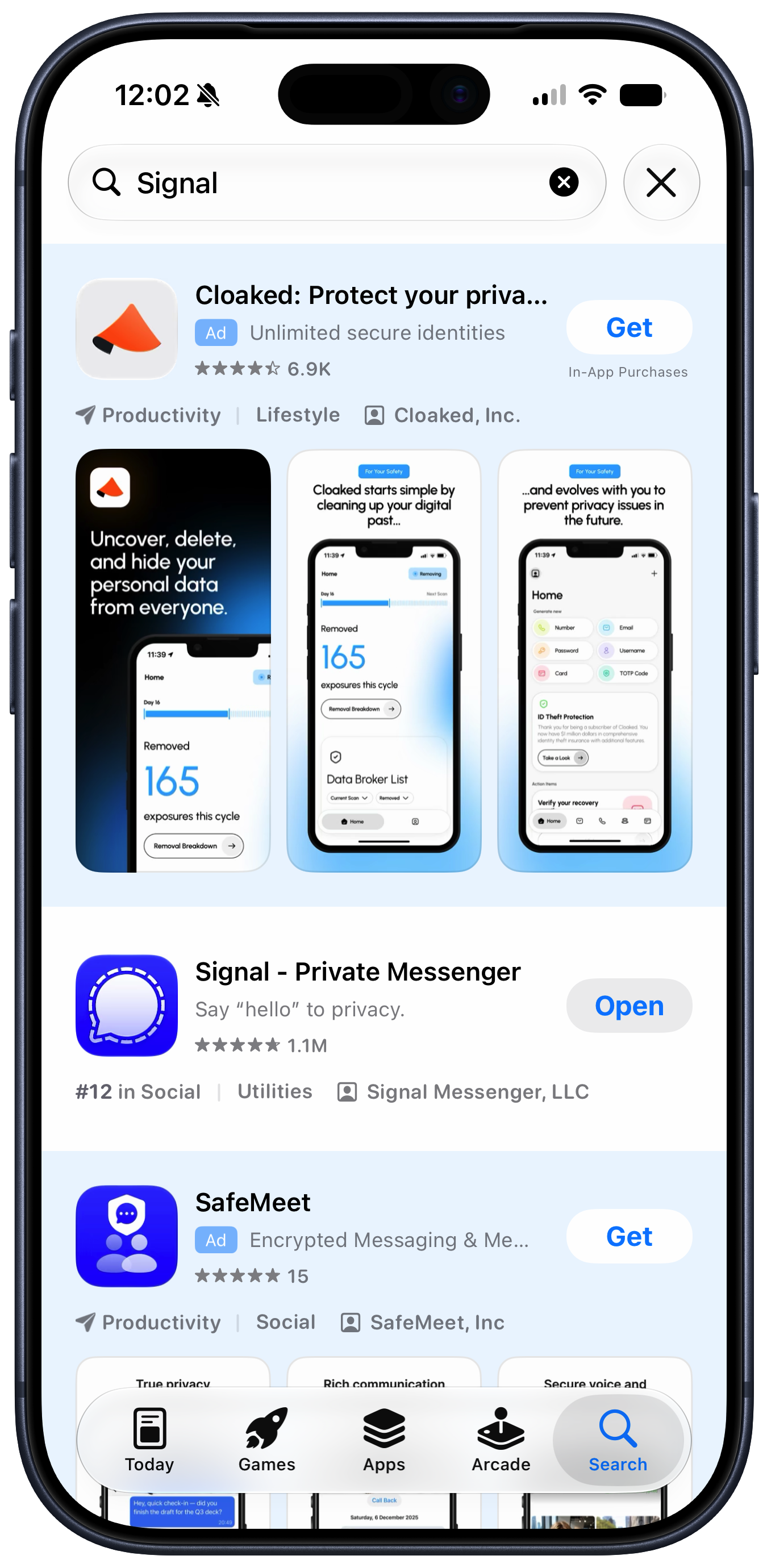
Putting themselves in customers’ shoes today, how many ads do Apple’s executives want stuck in the results when they search for an app in the App Store? We know the honest answer. But the answer evidenced by the actual App Store is “Two really big ones, including one in the first spot.”
At least you could peel off the stickers.
Jason Snell:
While Apple can spin adding ads to Apple Maps as a revolutionary new way for businesses to be discovered, it’s telling that its initial announcement was hidden inside a press release about an entirely different product, and introduced as “Enhanced Discoverability in Apple Maps.” Those choices show that this isn’t something Apple is actually proud of—and that the people in charge of communicating and explaining Apple’s decisions to the world are at odds with those who are making the decisions about expanding revenue.
[…]
To this day, you’re confronted with an ad for Creator Studio every time you create a new document in those apps, and their default toolbars contain buttons that won’t work unless you subscribe to the bundle. As a result, Apple has essentially turned its free productivity suite—software that was designed to enhance the inherent value of Apple’s products—into a freemium package with upsell to a creative professional subscription bundle that’s irrelevant (and a terrible value!) for most of its existing users.
[…]
There are many more examples. Using notifications to promote subscriptions and badging the Settings app to push AppleCare plans are among the ways Apple has chosen to intervene in the user experience to drive revenue. I’m actually not opposed to the idea that Apple should communicate opportunities for its customers to get more out of their devices—but it should be careful not to cross the line into actively annoying those customers. If someone doesn’t want to see what you offer, you need to accept that and go away—not keep needling them. Apple often falls on the wrong side of that line.
[…]
It makes me wonder if the people making these decisions at Apple have lost track of the Apple brand and what it stands for.
John Gruber:
What Snell’s column makes clear is that the incremental revenue Apple is gaining from putting shitty ads in its software comes at a price. They’re withdrawals from Apple’s brand equity. And I would argue that the value they’re detracting from the brand far out-values the dollar amount they’d padding to Apple’s bottom line.
[…]
If your competitors’ stores all smell like dogshit, don’t aim to have the store that smells the least like shit. Aim to have a store that smells pristine. “Our stores only carry a vague whiff of dogshit” is not insanely great.
Hotelling’s Law, like I was saying.
Adam Chandler:
This is not an “update”. This is an advertisement.
Update (2026-07-29): John Gruber:
The people haven’t changed, but Apple has. Strong leaders inevitably shape the personality — the spirit — of organizations over time. Apple in 2011 was peak Steve Jobs Apple. Apple in 2026 is peak Tim Cook Apple. But it was Cook who popularized the “you’re not the customer, you’re the product” argument against “free with ads” online services. But that was in 2014.
Marcin Wichary:
“Slippery slope” is a perfect term. But I wanted to add something here. In my experience, in the realm of UI, there is no middle notch. I’ve seen it time and time again… the moment you open the door to One, Infinity starts exerting its pull[…]
Previously:
Update (2026-08-03): Jon Snader:
I HATE, HATE, HATE having ads pop up when I’m trying to do something else. It’s bad enough on Web sites where at least they have the excuse of having to make money some how but it rises to intolerable when they put them up on a device I’ve already paid for.
The annoyance is reason enough to dislike Apple’s ads but for me the worst thing is that they’re corrupting and inevitably lead to the user being replaced by the advertiser as the customer.
Update (2026-08-05): John Gruber:
Only search engines that agree to pay Apple for the traffic are in the list, and there’s no option for users to add custom ones.
Tyler Hall:
It says a lot about modern Apple that I can’t find an unsubscribe link in this marketing email.
John Gruber:
Apple News ads have been going down the toilet for years, but it didn’t used to be literal.
Advertising Apple Creator Studio Apple Maps Apple News Apple Services Business iOS iOS 26 Mac macOS Tahoe 26 Marketing
Wojciech Reguła:
Looks like moving the user’s TCC db to /private/var/containers/Data/ProtectedSystem/[UUID]/Data/Library/Application Support/com.apple.TCC/ was not the only change in the whole privacy castle of macOS 27. (What btw was a great move as now attackers with full disk access permissions can’t modify your privacy settings)
macOS 27 quietly ships a new privacy mechanism I hadn’t seen documented anywhere: it extends the com.apple.macl protection that has always guarded sandboxed apps’ ~/Library/Containers/<bundle-id>/Data folders to a hand-picked set of non-sandboxed apps’ ~/Library/Application Support/<name> folders too. I noticed it by accident — Firefox’s profile folder was suddenly inaccessible from Terminal, while MacPass, a password manager sitting right next to it, was wide open. That asymmetry didn’t sit well with me, so I pulled the thread. It ends in a hardcoded app allowlist baked into /usr/libexec/sandboxd (thx @ciphwall for the hint), meant to be updated live via XProtect.
Previously:
Mac macOS 27 Golden Gate Privacy Security Transparency Consent and Control (TCC)
Jeff Johnson:
Although you can hide and unhide apps in your App Store purchase list, it turns out that hiding an app in the App Store purchase list does not hide the app in the updates list! I honestly can’t figure out the benefit of hiding an app in the App Store. The list of your purchased apps—a misnomer, as the list includes free apps—is practically unusable anyway: you can neither sort nor search the list. Maddeningly, the Mac App Store sorts your purchased apps by date of first install rather than by name, so it’s difficult even to scan the list manually to find a specific app.
[…]
You can clear the Updates list in the Mac App Store by deleting some cache files on disk, but that’s at best a momentary solution. The unwanted update will return eventually, or immediately if you use the Reload Page (⌘R) command.
A more lasting solution is, counterintuitively, to install the update. The trick is that you can keep more than one copy of a Mac App Store app on disk.
I wonder how long you can keep using the old version. You won’t be able to download it again. You can save a backup, but as some point a certificate will expire or you’ll get a new Mac and need a new receipt file. In theory, the store should be able to fetch one for you, but I wouldn’t rely on that long-term.
Previously:
App Store Receipt Validation Mac Mac App Store macOS Tahoe 26
Marcin Wichary:
This instruction is a fever dream of three weird things in sequence:
- What on earth is “QuickTime”?
- I am recording with a player?
- Why can’t I choose the option [“New Screen Recording”] that describes exactly what I want to do?
[…]
It’s noticing this kind of complexity, places where an easy way was chosen, design debt accumulated, and things got simply too weird. Apple allowed three weird things to accumulate here.
It makes sense in terms of the history and how the technology works, but from a clean slate one might expect this functionality to be in the Screenshot app, Screen Sharing, iPhone Mirroring, or perhaps even Finder.
Previously:
History iOS iOS 27 Mac macOS Tahoe 26 QuickTime Screen Recording Video
Thursday, July 23, 2026
AP (Hacker News):
A federal judge has approved a $1.5 billion copyright settlement in which artificial intelligence company Anthropic will pay thousands of authors about $3,000 per book after using pirated copies of their works to train its Claude chatbot.
[…]
Bestselling thriller novelist Andrea Bartz first brought the suit with two other authors in 2024. It’s the first major settlement in dozens of AI copyright lawsuits that are still working their way through courts.
Dare Obasanjo:
Somewhat ironic given recent claims from Anthropic about others training their AI on its work.
Previously:
Anthropic Artificial Intelligence Claude Copyright Lawsuit Legal Web Crawlers
Tim Hardwick (Wired):
Google was today fined €890 million ($1 billion) by the European Union for breaching antitrust rules with regard to its search and Google Play store services.
The European Commission found that Google had broken the Digital Markets Act (DMA) by using its dominant position in the search market to favour its own services, like shopping and hotel deals, over those of rivals.
The Commission also said that the company had abused its position by preventing developers from directing users to cheaper ways to buy apps and app subscriptions on websites and alternative app stores.
Sergiu Gatlan:
The Commission noted that Google has begun testing changes to how its own services are placed in search results and rolled out changes to its steering terms, which the EU’s main executive body described as substantial progress towards compliance.
“Google has fallen short of effective compliance with the Digital Markets Act, and today we have taken decisive yet balanced enforcement action sanctioning these breaches,” said Teresa Ribera, Executive Vice-President for Clean, Just and Competitive Transition.
“The best products should succeed because they’re better, not because they’re owned by the company running the search engine. And European consumers have a right to be told by app developers where to sign up to the best offers, even when the app store owner does not get a cut.”
John Gruber (Mastodon):
With search, Google is required to share with competitors — search engines and AI chatbots alike — a massive amount of user data from Google Search user interactions. What terms people search for, what they click on in results, what languages and devices they use. It’s all ostensibly anonymized but that’s tricky when it comes to search terms. A lot of the terms people type into web search fields are to some degree personally identifying. The EC seems to be saying it’s Google’s problem to filter out things like passwords and usernames and omit them from the shared datasets. Google can charge money for this access, but only under “fair, reasonable, and non-discriminatory (FRAND)” prices, based on a Commission-defined methodology.
Previously:
Update (2026-07-27): John Gruber:
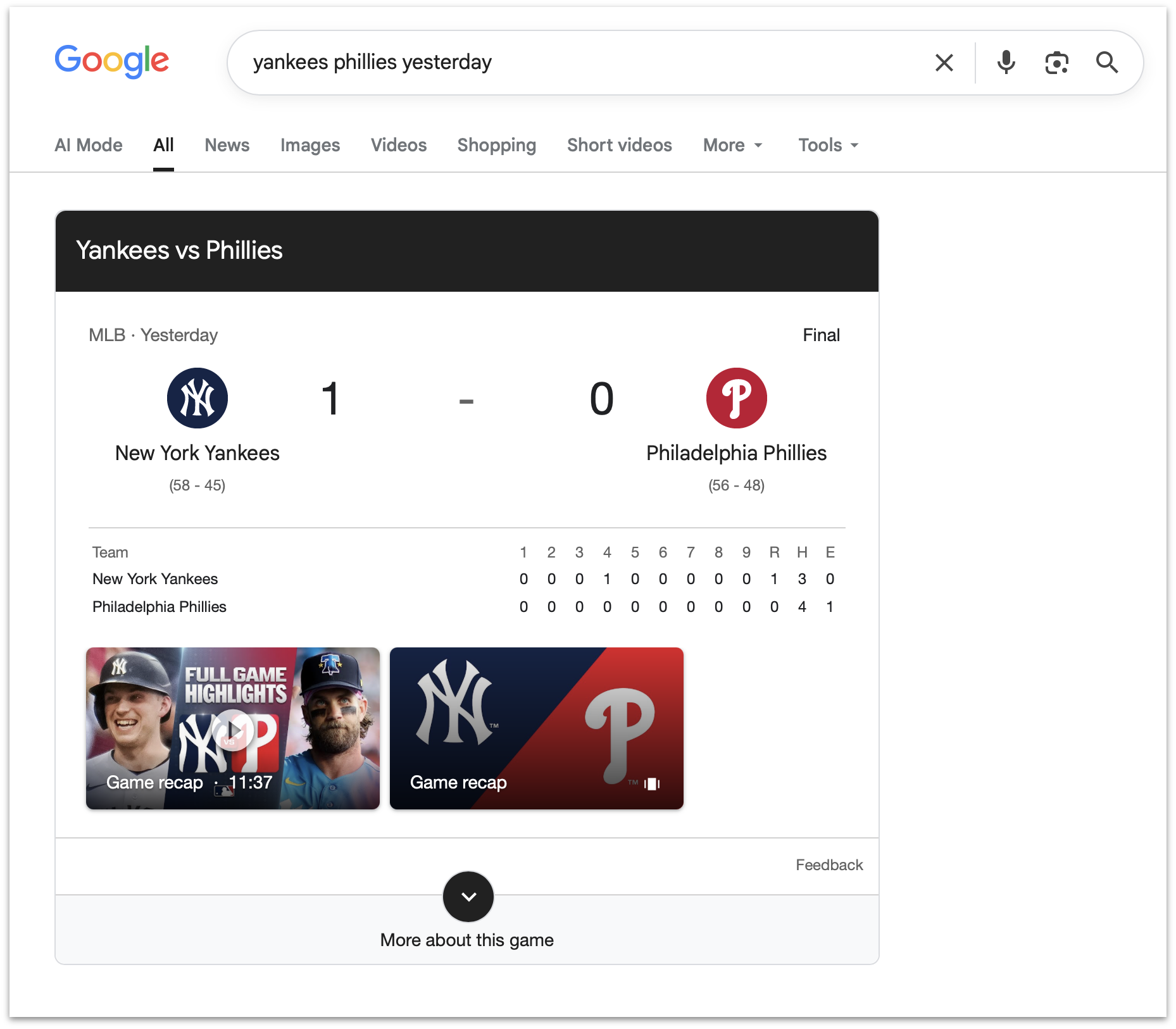
So if you search for the score of a sporting event, it’s illegal in the EU for Google to show you the score, like this search I just tried. What the EC is saying is that because Google Search is so popular, it’s no longer allowed to improve.
plantain:
It drives me insane when in Europe the link between Google Search and Google Maps is broken and I often have to copy paste an address between the two. Thanks EU, what if I like Google’s integrations?
phiresky:
They could have simply added a selector when a user first clicks on the maps preview in the search result, and then remembered it on device or across that user’s account.
But of course, then the user could choose a competitor’s product and Google would have to honor it. That would be horrible, so instead they just made the user experience worse for everyone and elegantly made people blame the EU.
See also: Hacker News.
Antitrust Digital Markets Act (DMA) European Union Google Google Play Store Google Search Legal
Ryan Whitwam (PDF, Reddit):
Back in 2018, Google was handed a record-setting 4.34 billion-euro ($4.9 billion) fine in Europe for abusing its monopoly on Android. The company has spent the intervening years challenging that decision, but the continent’s highest court has put a stop to that. The Court of Justice of the European Union has affirmed the penalty, meaning Google is out of options.
[…]
The EU took issue with Google search and Chrome being the default options on Android. Even devices made by other companies, such as Samsung and Xiaomi, include Google apps as the default per the Android licensing agreement, giving Google an unfair advantage, according to European antitrust regulators. This is not to be confused with a 2.95 billion euro ($3.45 billion) fine against Google’s advertising monopoly issued by the European Union last year.
Arjun Kharpal:
In 2022, a lower EU court reduced the fine to the current 4.1 billion euros from 4.34 billion euros previously.
Google has argued that the Android operating system provides choice for users and supports developers and businesses across Europe.
Via John Gruber:
Google last year booked $132 billion in profit; this fine is about 3 percent of that..
[…]
There’s never a reason not to string the appeal process out, but it’s especially true when your profits are growing at an exceptional rate. By growing their profits around 5×, they’ve reduced the relative sting of this fine by 5×
Previously:
Android Antitrust Business European Union Google Google Chrome Google Search Legal
Marcus Mendes:
Apple’s requests to overturn a $634 million patent verdict and secure a new trial in its long-running legal battle with Masimo were denied.
Wesley Hilliard:
There doesn’t appear to be any other path for appeal or recourse, as the judge rejected both requests for either a new judgement or trial.
[…]
In the end, Masimo didn’t succeed in getting the Apple Watch banned or fundamentally redesigned. It won an empty victory with the funds it will be paid, and the patents affecting the lawsuit will expire in 2028 and 2029 anyway.
Paul Terpstra:
Although the ruling confirms the financial penalty, it does not affect current Apple Watch users. The smartwatch’s blood oxygen monitoring feature remains available after Apple introduced a software update in January 2024 that allowed sales to continue despite earlier legal challenges.
Previously:
Apple Apple Watch Lawsuit Legal Masimo Patents
Wednesday, July 22, 2026
Om Malik (2023):
One of the key advantages of MacWhisper, as it utilizes the Whisper technology, is its superior accuracy in transcriptions compared to other services I have used. I was an early adopter of Rev.com and eventually switched to Otter.ai, for which I paid approximately $100/year. However, I have since canceled my subscription.
[…]
After comparing the audio transcripts from MacWhisper and Otter, I found that while Otter’s formatting is superior, there is hardly any difference in the transcriptions. I started with the free model, which was sufficient for my needs, and eventually upgraded to the large models. Nowadays, I primarily use MacWhisper to transcribe my voice memos, which I then import into Lex.Page.
Bon Adamson:
Whisper, which is made by OpenAI, has the distinct advantage of allowing you to transcribe audio in almost any language you may ever need to. For the time being, Otter can only transcribe English. The benefits of better accuracy and accurate punctuation that the service already holds over Siri hold up across other languages as well. If you’re looking to transcribe non-English audio accurately, Whisper is definitely the best option available on Mac.
Dan Moren:
By taking advantage of OpenAI’s Whisper framework, Audio Hijack can now take any audio it’s recording and generate a text transcript. While this process was possible before—see Jason’s lengthy post about his workflow—it required a lot of fiddling and several different tools to accomplish; it’s certainly a lot easier to simply drop Audio Hijack’s block into your existing session. If you record multiple sources, it can even appropriately label each one—though if you record multiple people via one input, say the other end of a Zoom call, it can’t distinguish between the various participants.
Inscribe (2026, Hacker News):
Apple’s new SpeechAnalyzer is the most accurate on-device speech engine we tested. It beat every Whisper model we ship, including Whisper Small, on both the clean and the noisy half of LibriSpeech, while running roughly three times faster than Small. And the API it replaces, SFSpeechRecognizer, came last on clean speech: behind even Whisper Tiny, a 40MB model.
[…]
The new API cuts word error rate by 3.5 to 4x on the same audio: from 9.02% to 2.12% on clean speech, and from 16.25% to 4.56% on noisy speech. There is no accuracy trade-off to weigh; the new API wins everywhere we measured, and it produces punctuated, cased text where the legacy engine’s output is rougher.
[…]
All five engines ran comfortably faster than real time: between roughly 12x and 40x on the M2 Pro, meaning an hour of audio transcribes in about 1.5 to 5 minutes on-device. SpeechAnalyzer was about 3x faster than Whisper Small per second of audio while beating it on accuracy.
Yuki:
SpeechAnalyzer’s ReportingOption.fastResults reads like a knob you’d reach for when you want to trade power for latency. That framing is what cost me the afternoon.
[…]
If a recording matters — and in a notes app, a lost meeting is the worst thing that can happen to a user — then the container you write while recording has to be PCM in CAF. Not m4a, and not AAC-in-CAF either.
[…]
AVAudioEngine’s inputNode silently ignores your device selection
[…]
I wanted summarization to run on-device. Everything else in Nib’s transcription path does, the audio never leaves the machine, and it would have been a much cleaner story to tell.
But 4,096 tokens for the Foundation Models isn’t enough.
Previously:
Apple M2 Pro Artificial Intelligence Audio Hijack Dictation Foundation Models Framework iOS iOS 26 Mac Mac App macOS Tahoe 26 MacWhisper Programming Speech Recognition
Thijs Xhaflaire (via Ric Ford):
Jamf Threat Labs discovers and investigates CrashStealer, a C++ macOS infostealer that impersonates Apple's crash-reporting framework to harvest browser credentials, cryptocurrency wallets and keychain data, encrypting stolen files with AES-GCM before exfiltrating them to a remote command-and-control server.
[…]
Unlike the payload it eventually installs, the dropper is properly code signed and notarized: it is a universal (arm64 and x86_64) binary signed with the Developer ID Emil Grigorov (WWB7JA7AQV), has hardened runtime enabled, and carries a stapled notarization ticket. Notably, the disk image itself is signed as well, not just the application inside it, which is uncommon in malicious DMG delivery where the container is typically left unsigned.
[…]
That file supplies the curl command the dropper runs next. Staging the first hop on a trusted developer domain keeps the initial network activity inconspicuous.
[…]
[The script] clears extended attributes on the staged bundle with xattr -cr, makes the inner binary executable, strips the payload's existing signature and re-signs it ad-hoc (codesign --remove-signature followed by codesign -s - --force --deep --no-strict), registers it with Launch Services via lsregister -f, and finally launches it in the background with open -g -n.
Previously:
Code Signing Crash Reporter Gatekeeper Mac macOS Tahoe 26 Malware Notarization Security
The Google Earth Team:
We’re continuing to make Google Earth on web and mobile (Android | iOS) the best place for people to get helpful geospatial insights. While you can continue using the legacy Google Earth Pro desktop app, it will no longer be available for new downloads beginning on June 25, 2027. We encourage using web and mobile for the best Google Earth experience.
Via Nick Heer:
This is a two-factor loss: the MacOS app is Intel-based and, thus, will no longer be supported by the system come next year.
[…]
On the Google Earth community thread, you will find comments from people with all sorts of interesting use cases for the desktop app.
Rui Carmo:
This is going to be the end of an era for me. One of the first things I did with the early versions of Google Earth was wire it up to Vodafone’s mobile network data, producing some genuinely unique–for the time, at least–visualisations of network usage over time.
Previously:
Google Earth Mac Mac App macOS Tahoe 26 Sunset
Tuesday, July 21, 2026
Malcolm Crawford (Mastodon):
The open-plan floors make it hard to concentrate. The building is so large that getting from one meeting to the next eats real time out of the day. It’s common for people to run meetings with colleagues over Webex — colleagues on the same campus, sometimes no more than two hundred yards away.
Ironically, Apple Park replaced a campus that did far better on the same measure without ever trying to. Infinite Loop produced far more of the accidental, cross-team contact Apple Park was explicitly built to create. Working out why starts with what Infinite Loop got right by accident. It continues with what the research on office proximity says about why that kind of thing happens at all. And it ends with what Apple Park could become instead — including a version of the fix Apple already trusts enough to run for a hundred people a year.
[…]
There’s no obvious focal point for the whole site — most sections have their own sitting area and their own coffee bar, but nothing plays the role Caffè Macs and the IL1 coffee bar played together at Infinite Loop. Caffè Macs at Apple Park seats a thousand people and feels built for throughput, not conversation. Everything is organised per-segment rather than around a shared centre, which is convenient for the people in that segment and useless for the discovery-by-accident that made the old campus work.
[…]
By multiple accounts from people who were there during design and construction, the site was flagged as under-provisioned for meetings and conferences before it even opened.
Via Jason Anthony Guy:
Apple Park is a beautiful structure, but is not terribly conducive to focused or collaborative work. Even as an occasional visitor I found it overwhelming. Employees sit shoulder to shoulder, voices bounce off and bleed through glass walls, and privacy is a virtual impossibility. My friends and colleagues who worked there regularly found it difficult to be productive.
I worked in Infinite Loop (Building 3, 2nd floor) for thirteen years (right below Developer Publications, where Malcolm spent a good portion of his Apple career). I loved IL because its design made serendipitous encounters easy. Whether it was sitting outside Caffè Macs or in the IL 1 Atrium, I would inevitably bump into someone and have a conversation that furthered an in-flight project, sparked something new, or simply reinforced the social ties that bind colleagues.
It helped that at that time, Apple had perhaps 10,000 employees, most of whom were in or near IL. After iPhone came about and IL started getting locked down, much of the natural collaboration dissipated, disappearing behind badged doors and disclosures.
Ken McLeod:
IL provided a place to focus on your work[1], as well as seating spaces that are out of the flow of traffic where you can have an informal meeting[2]. At AP, every collaborative space is effectively in the middle of a hallway. That turns out to be enormously distracting, both to you and to those people trying to work in the glass bullpen right next to it.
[1] before all cubicles and offices became multi-person shared spaces
[2] before all those spaces were filled in with more offices
Helge Heß:
“The IL1 atrium really was the crossroads of the company in those days” I really don’t think that this is true literally by any means. Assuming “those days” overlap with the time I’ve been there (pre Park). The XFs in IL have been extremely scarce.
IL was way too small and overloaded, I’d actually say it was very similar to Apple Park. No one really wanted to work there in those tiny offices with multiple people 🤷♀️
Steve Hayman:
I loved the IL1 atrium. I’d sit there and hope that someone like MMalc would wander by, and they often did. It was a real destination for field people who didn’t get to visit the mothership very often. I miss that. AP had nothing like it.
Eric Schwarz:
I think of my days in college—most dorms residence halls were not air conditioned, so at the end of August, you had to open your window (often to place a box fan) and door to create some airflow. People walking through the building would meet by chance. Newer buildings tended to be less lively and more like a hotel—all the doors closed and rarely much activity. Through renovations, most of the buildings have had air conditioning added, dropping those interactions over the years.
Previously:
Update (2026-07-22): Dr. Drang:
As you may know, the Lumon Industries building that Mark, Helly, Irving, and Dylan work in is a former Bell Labs facility in Holmdel, New Jersey. I first learned about the building several years ago, when I read Jon Gertner’s excellent history of The Labs, The Idea Factory. It’s a distinctive place designed by Eero Saarinen in the early 60s.
Bell Labs was known for the fruitful collaboration of its researchers, often started through chance meetings in the hallways of other Bell Labs facilities. The new Holmdel building was supposed to further that sort of teamwork, but things didn’t work out as planned.
macintog:
I worked in IL1 for over a decade. The day I saw the open-plan spaceship, I knew I would never set foot inside. There are more rewarding ways to work in a barn.
Apple Apple Park Design Jonathan Ive Steve Jobs Webex Working
Aleem Shaun:
I’ve used Day One for more than a decade. It was an excellent journalling app. Private, minimal, easy to use, with excellent features such as geolocation, weather, ‘On this Day’, and book printing. Features that got out of the way and either worked quietly in the background or appeared only when you summoned them. That’s changed.
Now there are new subscription tiers. Previously, the tiers were Free and Premium. Simple. Premium included sync and a few other things that I can’t remember, but it was compelling enough that I’ve been a Premium subscriber from the beginning. Now, without consultation, I’m Silver (not Premium), and there’s a new, more expensive AI-driven tier, Gold. I don’t object solely on that basis. You would think I could just choose to remain on ‘Silver’ and all would be well. But no. Even with these features turned off in settings, I’m visually prompted in the app to upgrade to Gold and use the Daily Chat (with AI), which I’ve turned off and can only use if I upgrade. And yet, there it is, taunting me.
Via Eric Schwarz:
Even Apple is guilty of doing this in the Settings app and the former iWork apps.
Previously:
Artificial Intelligence Day One Journal iOS iOS 26 iOS App Mac Mac App macOS Tahoe 26
Chance Miller:
Here are the new monthly prices for Apple Music and Apple One as of today:
Apple Music
Apple One
The price increases for Apple Music come after Spotify announced its own round of price hikes earlier this year, which Apple poked fun at on social media. Even with today’s price hikes, though, Apple Music remains cheaper than Spotify.
Lee Peterson:
Apple Music no longer makes sense when I’m already paying for YouTube Premium. Apple Music goes up to £11.99, YouTube Premium is £12.99 and on top of a good music service you get no ads on YouTube.
Mike Rockwell:
Distilling my longtime argument down to its simplest bit, I’d ask “do you want to pay $10 a month for music for the rest of your life?”
But truly, it was never going to just be $10 per month. The price was going to go up over time. It was going to get more expensive to have access to the same music.
If you purchase your music, though, I think most people would reach a point in their life where they stop buying new music entirely or they’re only buying a few albums per year. The cost of music would go down for you over time.
That was my thinking, too, but then I found that music I’ve purchased from Apple won’t work on my HomePod. I refuse to condone that behavior, so now I have two solid reasons not to subscribe to Apple Music.
Joe Rossignol:
While the monthly and annual prices of AppleCare+ plans for Macs and iPads received a slight increase this week, AppleCare One continues to start at $19.99 per month in the U.S., making the multi-device plan even more valuable.
Previously:
Update (2026-08-28): Joe Rossignol:
As a result of the Apple TV price increase, the Apple One Individual bundle has also gone up in price, with all of today's changes outlined below.
- Apple TV (Monthly): $14.99 per month (up from $12.99 per month)
- Apple TV (Annually): $119 per year (up from $99 per year)
- Apple One (Individual): $21.95 per month (up from $19.95 per month)
Benjamin Mayo:
Apple TV is now just as expensive as the Apple TV!
Previously:
Apple Music Apple One Apple Services Apple TV+ AppleCare Business Music
John Gruber (Mastodon, 2):
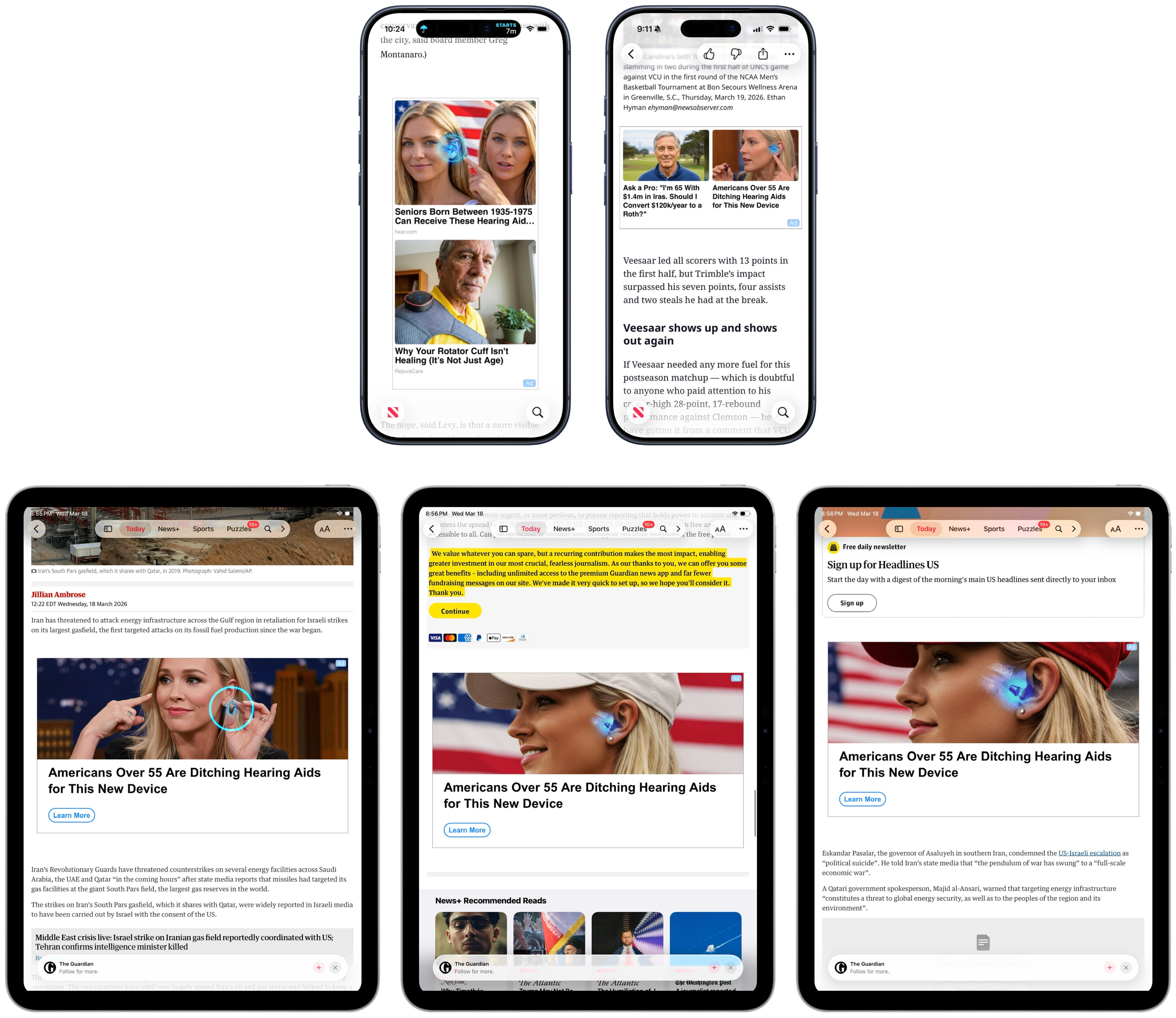
Some of [Cook’s letter] remains true, but has lost some truthiness — and truthiness matters. But some of it is no longer true, period. It’s no longer just “one small part” of Apple’s business that serves advertisers. Here in 2026, search results in the App Store not only show paid ads — frequently for casinos — but the search results are visually dominated by paid ads now that Apple has added a second ad to results. Apple News+ is a paid subscription that offers a genuinely great value for the number of paywalled publishers whose content it includes, but articles on the News app tend to include the weirdest AI-generated ads on the Internet. (How many young blond women am I supposed to believe need hearing aids?) And — at this writing, still “coming soon” — Apple is launching ads on Apple Maps. Apple Maps remains free of charge to use, so according to Tim Cook, we’re not the customer. We’re the product. Or, if you prefer, our frustration is the product.
[…]
The ratio of ads to organic results in App Store search — especially when measured in screen area — is clearly not aligned with Cook’s 2014 statement that “Our software and services are designed to make our devices better. Plain and simple.” Obviously not. App Store search today is designed primarily to generate more revenue for Apple. That’s not criminal, but it’s a change.
[…]
What gave Tim Cook’s privacy letter heft in 2014 wasn’t just the clarity of its plain language, but the fact that you didn’t have to take his word for it that the ads Apple showed you respected your privacy, because Apple didn’t show you ads in 2014. Apple today can’t say that.
[…]
John Ternus should return Apple’s privacy policy to its 2014 clarity. The trust Apple would earn from such a move would far out-value whatever revenue these ads pad to their already hefty and ever-increasing quarterly Services numbers.
I wish that were the case, but I fear this is kind of a Hotelling’s Law situation, where Apple can get most of the benefit by being just slightly better on this axis. Where else do its customers have to go?
Jeff Johnson (Mastodon):
In the second fiscal quarter of 2018, services generated $9 billion in revenue (net sales), whereas in Q2 2026, that amount had grown to $31 billion! In this blog post, I want to focus on understanding the relative financial importance of products and services for Apple.
[…]
In 2025, services were 42% of Apple gross margin. How does 26% of net sales become 42% of gross margin? The explanation is that services have a much lower cost of sales. The products gross margin was 37% of products net sales, while the services gross margin was an astonishing 75% of services net sales. In other words, Apple services are almost pure profit!
Does this 75% account for TV and movie production costs?
With persistent general inflation, consumers do not have unlimited money to spend on Apple products. At least in the near future, it’s reasonable to question how much further room is available for growth in profits from Apple products. To satisfy the demands of investors, Apple executives including CEO-elect John Ternus may be forced to rely even more than before on growth in services, which do not face as much pressure on cost of sales as hardware products.
Previously:
Advertising Apple Apple Services Apple TV+ Business iOS John Ternus Mac Tim Cook
Monday, July 20, 2026
Jared Sorge:
I know there are options out there like Paddle, FastSpring, and Lemon Squeezy that have worked for many apps like mine over the years. But I also wanted something simple for my users. Not to mention Apple Pay was a must-have.
I believe all the services he mentions do support Apple Pay.
RevenueCat serves as the source of truth for whether or not a customer is licensed.
I create RevenueCat customer IDs from local iCloud identifiers (more specifically, calling userRecordID() on my CKContainer in CloudKit).
When the user makes a purchase, they earn an entitlement that I look for in Arborist to grant them a license.
He doesn’t need to run his own server, and the purchases are automatically tied to the user’s iCloud account, so there are no e-mails or serial numbers to deal with. On the other hand, well, it’s all dependent on the Apple Account.
The app, which helps manage Git worktrees, is shipping now.
Previously:
Apple ID Apple Pay Arborist Business Git iCloud Mac Mac App macOS Tahoe 26 Payments RevenueCat Stripe Version Control
Bruno Brito (release notes):
In Tower 15, we introduced the “Fully Merged” badge and Automatic Branch Management to help you keep your repository tidy. With Tower 17, we’re taking the detection behind that badge to a whole new level. […] Tower now matches your local branches against merged pull requests from your hosting service, such as GitHub or GitLab.
[…]
Trust is everything when deleting branches — so we redesigned the “Fully Merged” hint view to show you exactly which checks matched.
[…]
One that is particularly noteworthy is that updating submodules is now significantly faster! Tower gathers each submodule's Git data concurrently instead of one at a time—something you will especially notice in repositories with many submodules.
I’m sad that they got rid of the yellow icon.
Previously:
Developer Tool Git GitHub GitLab Icons Mac Mac App macOS Tahoe 26 Programming Version Control
Federico Viticci (Mastodon):
The AI frontier from the two big labs (and – we have to be honest with the numbers here – probably SpaceXAI and Meta now, too) is in a completely different league at the moment. I spent my first couple of weeks with Siri AI trying to convince myself that I could replace Codex with Siri AI, and that was the wrong approach. There is a potential future in which Siri AI can become a more proactive and capable agent, but that’s not what Apple is shipping this year.
[…]
Siri AI is a dramatically better Siri for typical Siri stuff. The new Siri understands your commands and nuanced requests better because of the LLMs behind it; it can often perform multiple requests in one go (such as setting multiple timers with one command); the new expressive (and customizable!) voices sound great, and they’re terrific at reading and summarizing notifications. Apple’s first advantage compared to other chatbots is right here: only Siri can integrate with the iPhone and iPad to this extent, so even if the Foundation models aren’t as smart as the competition, Siri can do a lot more for most people on their devices because neither OpenAI nor Anthropic have OSes they can control.
[…]
The biggest issue I’ve encountered is the inconsistency of it all. Very often, the new Siri AI still replies with a generic “Uh oh, something went wrong“ error that doesn’t explain what the error was or why it happened. Sometimes, I ask a question via voice, and it errors out, but then a few seconds later, I type the same question in the app, and it’s fine.
[…]
My problem is that, right now with Apple’s own apps, both the index and Siri’s ability to perform actions are very inconsistent. The assistant hallucinates abilities it doesn’t have, and it frequently just doesn’t work.
Dan Moren:
The good news is that Siri AI is capable: impressively so, at times. In the lowest of low bars, it certainly beats the pants off the previous incarnation of Siri, but its access to your own personal data and all of the app on your phone also unlocks a host of new possibilities.
But it’s also not without the pitfalls that underlie all LLM-powered chatbots: errors in understanding, hallucinations, and so on.
[…]
The app itself is pretty barebones, letting you view those conversations in List or Grid layouts, select multiple conversations to delete them, and pin or rename any single conversation. In Settings : Siri, you can choose to either open to the overview or to a new conversation and decide whether old conversations are kept for 30 days, 1 year, or forever. It’s a little strange that one-off queries (“What’s the average height of the Norwegian World Cup team?”) are stored alongside more involved conversations (“Can you help me build a specific RSS feed for this site?”); I also ended up with a few orphan blank “New conversations” which I deleted, but it’d be nice if you could filter to find those. Conversations are fully searchable and sync between devices via iCloud.
John Voorhees:
Despite the current limitations, if you use chatbots as a replacement for Google Search, you’ll probably have a good experience with the new Siri app. That’s because even in these early betas, if you ask Siri something like, “Give me a day trip itinerary for a trip to Chicago this Saturday,” you’re likely to get good but pretty middle-of-the-road recommendations. From there, though, you can drill down with follow-up queries to get something more in line with your tastes. The results include source links you can follow, too. Given the ad-strewn mess that web search has become, using Siri for this sort of thing is a meaningfully better experience.
The one caveat on Siri’s world knowledge is that it’s roughly 2-3 weeks stale in some places.
[…]
A good example is Music. You can prompt Siri to play a song, but most of the rich metadata in the app isn’t exposed to Siri, which is a shame because it is exposed elsewhere, for example to AppleScript.
Previously:
Update (2026-08-04): Benjamin Mayo:
Thanks to the top-to-bottom revamp that is Siri AI, Siri is reliably intelligent. Finally. We are still in the midst of beta season, and Apple is yet to confirm whether Siri AI will formally launch with iOS 27 in September or sometime later in the year, but the feature is up to scratch. There are bugs and glitches and edge-case quirks, but on the whole, it wipes the floor with old Siri and is competent enough to supplant my everyday usage of other chatbots too.
[…]
Siri AI can get a snapshot of what’s on screen, but it cannot control the UI for you autonomously. As such, if you ask it to do something outside of its library of available app actions, it will say it can’t do that. Often, it can quote the relevant steps for you to do it yourself, but obviously that falls short of the ideal experience. This feels a bit lacklustre to people already embracing AI agents en masse. Claude and Codex on Mac do not hit these walls; they are all too keen to move your mouse for you and run terminal commands until the job is done.
Previously:
Apple Intelligence Artificial Intelligence iOS iOS 27 Mac macOS 27 Golden Gate Siri
Wade Tregaskis:
In short: if you have any file in your app (or whatever it is you’re trying to get Apple to sign) that is over 4 GiB, you must use a disk image (DMG) to package it for notarytool, not a zip file.
This is because support for files larger than 4 GiB requires using the “Zip64” zip file format, which would be fine except Apple’s notary servers can’t handle them.
Previously:
Update (2026-07-22): Rosyna Keller:
It’s recommended to notarized exactly what you’re going to ship to users and shipping zips is extremely risky because you never know what tool the user will use to decompress the file.
Multiple unzipping tools will strip necessary extended attributes that could cause the code signature to fail to validate. This is especially true if you put non-code files in “code places” and they have to be signed with an extended attribute.
Mac macOS Tahoe 26 Notarization Programming ZIP Archive
Friday, July 17, 2026
Matt Burgess (MacRumors, ArsTechnica):
On Thursday, San Francisco city attorney David Chiu sent legal notices to Apple and Google demanding that they remove from their app stores 13 face-swapping apps, which allow users to create AI-generated nonconsensual nude images. The letters say the Silicon Valley giants should stop “aiding and abetting” the sale of explicit deepfake images and “sever” business relationships with the app developers.
[…]
Researchers have repeatedly found and reported apps in Apple’s App Store and Google’s Play Store that allow people to generate sexual images using AI—including some apps being rated as suitable for use by children. While new laws and bans aim to tackle the scourge of explicit deepfakes online, technology and social media companies consistently direct millions of people toward the harmful tech.
Both Apple and Google have developer policies that prohibit pornography, abuse, and harassment on their platforms.
Burgess gives the impression, which is my base assumption, that these 13 apps were clear about what they do, so App Review has no excuse for missing them. But I’m sure it’s keeping us all safe in other regards.
Meanwhile, in a preprint research paper published in May, researchers from Cornell University and Georgetown University identified 420 apps offering general face-swapping capabilities on Google’s and Apple’s app stores. They tested 155 to see if they could be used to create face swaps with nude images; in 70 percent of cases, it was possible, with the apps not including safety measures to prevent this.
Previously:
Update (2026-07-21): Danny Bradbury:
Chiu isn’t arguing that hosting an app automatically makes a platform liable for what it does. Platform operators already won that battle with Section 230 of the Communications Decency Act. That 30-year-old law says websites generally aren’t responsible for content posted by users, allowing platforms to host user-generated content without getting sued every time someone defames someone in a comment thread.
Courts have often extended those protections to cover app stores too. Apple and Google are treated as distributors of whatever a third-party developer uploads, rather than publishers.
Chiu is attempting to sidestep that argument by focusing on the companies’ payment systems, noting that Apple and Google collect a cut of every in-app purchase. According to the Tech Transparency Project (TTP), that means they profit from apps that generate revenue by creating non-consensual intimate imagery.
Update (2026-08-20): Marcus Mendes:
WIRED reports that Meta ran ads for a now-pulled App Store app that let users create AI-generated pornographic deepfakes of real people, with one of the ads featuring a woman resembling a prominent US politician.
App Review App Store App Store Takedown Artificial Intelligence California Google Play Store iOS iOS 26 iOS App Legal
Hartley Charlton:
The European Commission yesterday adopted new exemptions to its Batteries Regulation that free the Apple Watch and AirPods from having to offer user-removable and replaceable batteries.
[…]
The reasoning largely mirrors why devices like electric toothbrushes were already exempt: Opening a compact, sealed enclosure and failing to reseal it properly could let water in and create a safety risk. Products can also qualify for exemption if their construction makes battery removal inherently dangerous, or if there is no realistic way to build in user access given current manufacturing methods.
[…]
The iPhone was already exempt from the removability rule under the original regulation, thanks to its battery cycle life and water resistance rating.
Marcus Mendes:
Although the Commission has adopted the exemption, it must still undergo scrutiny by the European Parliament and the Council of the EU.
[…]
To read the European Commission’s full delegated act, follow this link.
Previously:
Update (2026-07-20): See also: Hacker News.
Update (2026-07-30): Rui Carmo:
This is one of those exceedingly rare cases where EU legislation has produced an unambiguously good outcome: from February 2027, Logitech’s European wireless devices will ship with hard-pack, user-replaceable batteries, and Logitech will sell certified replacements.
AirPods Apple Watch Battery Replacement European Union Hardware iPhone Legal Unauthorized Repair
Hartley Charlton:
Reuters reports that China’s Cyberspace Administration registered Apple’s on-device generative AI service this week, putting it on a list of newly cleared providers that also includes homegrown systems from Chinese phone makers.
An unnamed source told the outlet that Apple’s AI features in the country will draw on models from both Baidu and Alibaba.
William Gallagher:
China has complex requirements for regulatory approval, and sufficiently so that US firms typically need to involve a local partner.
John Gruber:
This isn’t about Siri AI, announced last month at WWDC for iOS 27 — this is the initial approval for Apple Intelligence, which was announced two years ago and rolled out in iOS 18.
Previously:
Apple Intelligence Artificial Intelligence Baidu Cali China iOS iOS 27 Mac macOS 27 Golden Gate
Thursday, July 16, 2026
Paul Kafasis:
With last year’s release of MacOS 26 (Tahoe), Apple made a mess of app icons. In the first betas of MacOS 27 (Golden Gate), however, there are signs of a turnaround. We’re urging Apple to continue making improvements, by restoring the ability for MacOS app icons to have distinct shapes.
[…]
After decades of beautiful, memorable Mac icons in varying shapes, Tahoe flattened personality to obtain bland uniformity. The platform is worse for it.
Past icons weren’t just more expressive. They were also more usable. Having distinct shapes provided a useful way to tell icons apart. Tahoe eliminates that cue by forcing everything into the same squircle, leaving color as the primary way to tell icons apart at a glance.
Jason Snell:
Kafasis makes the important point that uniform shapes make it more difficult for users, especially those with vision issues including color deficiency, to differentiate between icons.
John Siracusa:
Squircle Jail is the worst design-related thing Apple has ever done to Mac developers, and probably the worst icon-related thing it has ever done, period. Incredibly developer-hostile.
If squircled icons are actually better, then let that design win in the market. That’s how we transitioned from the classic Mac OS icon style to the more photorealistic Mac OS X icon style. Developers adopted it because they wanted to, and because users desired it.
John Gruber (Mastodon):
The squircles, I will point out, are not in and of themselves the problem. The problem would be the same with any mandated shape, like, e.g., VisionOS’s circles.
[…]
I can’t think of any other design crime Apple has ever foisted on Mac developers that I’d argue (with Siracusa) was worse.
[…]
It’s like Apple decided every single one of its own apps must wear a stupid-looking hat, and they put those stupid-looking hats on third-party apps too, whether the developers of those apps want them or not. Scratch that. Not hats but helmets.
[…]
Just the mere silhouette of the old Keynote icon is more recognizable, and thus more iconic, than any icon on any platform from Apple today.
Jeff Johnson:
The traffic sign analogy hits me personally, because the StopTheMadness icon used to be shaped like a stop sign, but I was practically forced into making it a generic road sign.
Gus Mueller:
I get why Apple did it, but I think it’s completely wrong for the Mac.
Marcin Wichary:
On his blog, Jim Nielsen writes how Apple filed away so much expression by forcing rigid icon bureaucracy in macOS. Nielsen focuses mostly on distinctiveness; previously, you could make the icon unique by its general shape or the shape of its contents, but one of these two levers has now been taken away[…]
[…]
However, one also can’t help but notice how ugly and amateurish the Creator Studio icons are, so it all feels absolutely like a net negative – the new system took something away and the proposed replacement feels low quality[…]
Rui Carmo:
I, too, find the squircles aesthetically offensive and utterly pointless.
[…]
The part that genuinely breaks my brain, though, is that I now find icons on Linux more distinctive than on macOS, which would be impossible for my ten-year-ago self to believe. The platform that built its reputation on craft and visual identity has spent a year sanding it off, while the one everyone used to mock for its inconsistency is where individuality survives.
Jeff Johnson:
The subliminal, Orwellian message of the squircle jail is that all software is subservient to Apple, merely accessories to Apple devices, interchangeable cogs in the machine.
Mario Guzmán:
Had to grab the rest of the icons from #MacOSX Leopard. Gosh, they’re so, so pretty. So finely crafted. Gorgeous. Love it.
Dr. Drang:
I agree, but Apple’s 50th anniversary has gotten me thinking a lot lately about the early days of the Mac, so it’s only natural that my mind shifted to the highly constrained icons Mac applications had back then.
[…]
Many of the complaints about squircle jail are about the loss of icon elements that “stick out” from the rest of the design. As you can see, this idea was there from the very start; the hands stick out from the tilted rectangles.
John Gruber:
I never loved the hand on these icons. It felt too uniform. It functioned like a “this is an application” badge, but such a badge never felt necessary to me.
[…]
I think it’s less that Apple gave up on them and more that it came into focus that the “hand holding a pen over a diamond-shaped document” convention was intended for document-based apps. It signified “This is a creative tool that you use to create documents”. Apps that weren’t about creating document files — like Disk First Aid and Font/DA Mover — got different icons. Font/DA Mover’s truck icon in System 2 signified that you use this tool to move things. Disk First Aid’s ambulance was an obvious metaphor for repairing something unwell.
[…]
But the main thing about the “hand holding pen over diamond” convention was that it was only ever a convention.
John Gruber (Mastodon):
(a) I don’t think this is a good mandate for iOS either;
(b) it was always so for iOS, though, so it’s not like Apple has ever taken away rich creative icon shapes on the platform;
(c) MacOS is a far richer and more precise environment than iOS.
[…]
App icons on the iOS home screen are effectively simple buttons. I think it’s rather obvious that’s why they have had that squircle/roundsquare shape ever since the iPhone was announced in January 2007 (source). They’re one-tap launchers. App icons in MacOS are not mere buttons. You can drag them, move them, and drop things on them. You click them to select, and double-click to launch. They are richer objects that deserve a richer visual vocabulary. iOS is a world meant for fat-tipped Magic Markers and blunt safety scissors. MacOS is a world meant to support fine-tipped drafting pens and precision razor-sharp X-ACTO knives.
Louie Mantia (Mastodon):
While developers have submitted full-bleed square images for iOS app icons since 2008, for these new squircle icons in macOS 11, Apple provided a template to compose app icons in an image editing tool like Photoshop, with full control over the canvas beyond the suggested—but not required—squircle. This template made it easy-ish for designers to compose macOS app icons that were identical to or synonymous with an iOS app icon, while leaving the door open to continue using arbitrarily-shaped app icons on macOS.
[…]
The second type of Squircle Jail is more controversial, because these app icons were specifically drawn with the intention of fitting in. Overriding that intention feels like punishment for having done the right thing. App icons in a style that was recently encouraged by the system are now scaled down and put inside the squircle as if it were a container. Every icon that was utilizing the previous squircle shape suddenly looks much worse than before.
[…]
Instead of taking care to design and develop solutions specifically for Mac and iPhone, newer and bigger companies that don’t only make apps often ship apps with logo icons, rather than app icons. We’ve all seen it.
[…]
I would love if Apple provided a way for designers to poke outside that squircle boundary. Some of my favorite app icons did that. But also some of my least-favorite app icons ignored this shape entirely, when it was used for every system icon in the last five years. Whenever those apps showed up in my Dock, it was like a stain on my shirt I couldn’t get out.
John Gruber:
Ultimately this is what I object to with the squircle mandate. It favors the bottom of the heap by restricting the top. It makes bad icons mediocre but pushes great icons toward mediocrity too. That’s not The Macintosh Way.
Nick Heer:
Mantia touches on all the pragmatic reasons to unify the shape of icons in an operating system, all of which I have considered, and then drops the above paragraphs — and things started to make more sense to me. This is a different way to think about it. This is not a situation where a cleaner looks like a zesty beverage with toxic consequences. The shared general function of these icons does help communicate something and makes them less ambiguous in that sense.
But a broad category of functionality is only part of the story of an icon and — with respect to Mantia’s long and illustrious history of work in this area, and that of co-Parakeeter Luka Grafera — taking away a difference of shape also limits what an icon can communicate. It may not be a cleaning product that looks and is packaged like juice, but imagine if every consumable liquid was in identical bottles with only a different label.
Steve Troughton-Smith:
Louie’s squircle jail post just underscores that the squircle jail benefits 99% of apps, and is better for the platform overall. There is only ever a handful of apps that make great Mac app icons, and a withering number of ‘great Mac app icon designers’ — you can probably only name one or two left in the scene.
Jeff Johnson:
Mantia talks as if it were more important for apps to “belong to the Dock” than to allow Dock users to quickly select the right app in the list. That’s choosing form over functionality.
“The shape of apps is a squircle.” But Mac users already knew those were apps in the Dock!
See also: Accidental Tech Podcast.
Tyler Hall:
If you’re lucky enough to distribute an app outside the Mac App Store, you can break free of squircle jail using NSDockTilePlugIn. It’s not strictly the intended use-case of that API. And it’s not allowed in the Mac App Store, either. But it can solve the problem.
BasicAppleGuy:
If you recognize these icons, it’s probably time to schedule your routine back exam.
Previously:
Update (2026-07-17): Louie Mantia:
But my perspective right now is to be very pragmatic. The decision to mask all icons with squircles is a long-time coming. It was perhaps the most predictable thing to happen in Apple’s history. For 20 years, it’s been leading up to this.
I want to make nice things for macOS, whatever macOS is. And this is what it is.
Roger Wong:
Some of my favorite icons over the years have had interesting shapes, like the truck for Transmit, the vise for Compressor, or the cute bird for Twitteriffic.
[…]
But I also recall clicking some icons and not being able to select them. Why? Because I was inaccurate in my click and instead my cursor landed in the empty space just outside the shape.
[…]
If I recall correctly, developers could use a different mask for the click target to help users out. But I don’t think many did all the time, including Apple, which you can obviously see in the video above.
Louie Mantia:
I don’t want to step on toes regarding your new [StopTheMadness] icon which has great color— but I don’t understand why you elected to abandon the octagon as the outer shape. That’s a choice. You are not forced to abandon it. Why not do something like this?
I like this.
Nick Heer:
Losing some of the artistry in an icon makes it more difficult to distinguish between legitimate and well-crafted Mac apps, and everything else. It is not a perfect proxy, to be sure, and there are some very nice squircle icons. But it is nevertheless a unfortunate change that makes apps of varying levels of quality look more similar.
Design Dock History Icons Liquid Glass Mac macOS 27 Golden Gate macOS Tahoe 26 StopTheMadness
Adam Engst:
Of the TidBITS readers who chose to respond to the poll, only 1% said they use clear icons on the Mac, and no one admitted to using tinted icons. On the iPhone, clear icons were twice as popular—a whopping 2%—and just 1% of respondents said they use tinted icons. Dark icons, which retain color, were slightly more popular, but still couldn’t exceed single digits, with 6% on the Mac and 9% on the iPhone.
Squircle Jail is one thing; redesigning icons to be assembled within Icon Composer is another. The latter makes a lot less sense but for supporting clear and tinted icons.
Previously:
Dark Mode Design Icon Composer Icons Liquid Glass Mac macOS Tahoe 26
Jason Koebler (tweet, Reddit):
The AI music generation tool Suno scraped millions of songs and lyrics from YouTube Music, Deezer, and Genius, as well as from the stock music libraries Pond5, Jamendo, Freesound, the International Music Score Library Project, and podcasts via RSS feeds, according to a hacker who breached the company and shared data about Suno’s training libraries with 404 Media. The hacker was also able to access user information for hundreds of thousands of Suno’s customers, as well as Stripe payment information, they said.
[…]
As part of these legal proceedings, Suno previously admitted that it was trained on “essentially all music files of reasonable quality that are accessible on the open internet,” which included a total of “tens of millions of recordings.” Suno has been making the argument that it is allowed to train on copyrighted works as fair use in those cases, one of which has been settled.
Corbin Bolies:
Suno has long acknowledged that its AI music generator relied on the scraping of millions of songs available across the internet, but a new hack reveals just how the company pulled from streaming services and websites[…] all while user information remained vulnerable.
[…]
“Our goal has always been to help people create original new music, not replicate someone else’s. That’s why we build our models around what we call ‘Original Creation, By Design,’” the spokesperson said in a statement. “For example, we intentionally do not use artist names as a category of training metadata because we want our models to help people create brand new songs, not music that replicates other artists’ existing work. It’s also why we built Suno with detection filters that block or prevent a user from using specific artist, song, or album names as prompts, and prevent users from uploading lyrics or sound recordings that match existing works.”
Previously:
Artificial Intelligence Breach Copyright Genius Lawsuit Legal Music Piracy Podcasts Suno YouTube
Wednesday, July 15, 2026
SpamSieve 3.3.1 is an update of my Mac e-mail spam filter that improves the filtering accuracy and includes various optimizations, fixes, and updates for macOS 27. Some interesting engineering issues were:
I’m still supporting macOS 10.13, but the app can now build with the macOS 12 deployment target in preparation for Xcode 27. The way Swift handles calling deprecated APIs remains annoying. You need workarounds like protocols to suppress a warning in a particular region of code. Often, I am updating to a newer API, but I want to continue using the old one on earlier versions of macOS. Right now I am heavily testing on macOS 26, so I would like to only deploy the new code there. Sometimes the initial versions of APIs are buggy, and I don’t want to have to retest every feature on every version. But Swift doesn’t like me to gate the calls to macOS 26 and later if the new API was actually introduced in, say, macOS 11.
The most risky update was probably switching to the Swift API for Scanner. This is tricky because the current scan position changes from being based on UTF-16 indexes to String.Index. And in some cases my code was intentionally scanning into the middle of a combining character. I was really glad to have extensive tests here.
Recent versions of Tahoe introduced a Core Data bug that broke save recovery (when invalid Unicode can’t be written to the database and we have to fix it up first). When the error comes in, SpamSieve looks under the NSDetailedErrorsKey key, but the value of this key is "NSDetailedErrorsKey" while the actual error info is under the key "NSDetailedErrors".
Database corruption combined with a Core Data bug and two Swift behaviors were causing crashes. The root problem, I think, is that in this situation Core Data neglects to set the error pointer for -[NSManagedObjectContext countForFetchRequest:error:]. Normally, Swift would detect this and throw a generic nilError. However, this method signals errors by returning NSNotFound instead of nil. It’s annotated as swift_error(nonnull_error), which I think means that Swift doesn’t even look at the return value, only the (unset) error. So my code was receiving NSNotFound on the non-error path, treating it as a real count, and doing some math with it, which (by default in Swift) leads to a crash if there’s overflow. Now my code checks for NSNotFound and uses Int.addingReportingOverflow().
I reimplemented Core Data batch fetching because of two problems with the fetchBatchSize option. First, it logs spurious errors when fetching from multiple stores at once. Second, it leads to high memory use. It will load objects in batches, but it never releases the earlier batches. You can manually refault objects that you no longer need, but it will still hold onto the full object shells, which can add up. My implementation only holds onto IDs, and it can fetch the IDs using a different context than the objects to push more work to background threads.
I’m now using String.makeContiguousUTF8() in various places to avoid slow iteration of bridged strings.
There was a regression where some menu code could crash on macOS 10.13. -[NSMenu setItemArray:] is only available on macOS 10.14 and later, whereas the getter is always available. With old Objective-C, the two methods could be annotated with separate availabilities. The Objective-C property syntax doesn’t allow this, so there’s no way for the compiler to flag calls where the setter is missing.
The AppleScript support works much better with large data sets. The key, I think, is to never return an array to Cocoa for a scripting property/element. First, if you give it a lazy array it will sometimes try to access all the elements even if it only needs a few. And, second, AppleScript will run out of memory if the array is too large. By using indexed accessors, you can maintain laziness and only convert one object to a descriptor at a time. By caching a batch-fetching collection, you can limit the number of fetches and respond quickly when AppleScript requests individual objects.
Previously:
AppleScript Bug Core Data Integer Overflow Language Design Mac Mac App macOS 27 Golden Gate macOS Tahoe 26 Objective-C Optimization Programming SpamSieve Swift Programming Language Unicode
Phil Gyford:
Flickr recently updated their iOS/iPadOS app to version 5 (App Store link) and, while it’s not radically new, for a service whose changes have been incremental over recent years it contains a lot of differences. However I’ve yet to find any official changelog or update information.
[…]
When displaying multiple grouped photos from a person you’re following, it is no longer possible to view all the subsequent ones, other than the three or four initially displayed.
In the list of your Followers’ photos, their name now appears under their photos, so you must scroll down beyond the photos to see who took them.
[…]
When zooming into a photo the app no longer loads a higher resolution version, so now the zoomed-in version will be very pixellated.
He has a long list of missing features that may or may not be coming back. And there’s what seems like a major change: tags can no longer use capital letters.
The main changes I noticed were:
In the Home/Discover view, when there’s a large group of new photos, you can only go into the group and view them individually, swiping to see each one. There’s no longer a way to see the whole group at once and scroll through it. (And tapping on the group icon or number of photos doesn’t do anything.)
Double-tapping to favorite doesn’t work in some situations.
The interface is more busy, showing more interaction chrome like other social media sites, rather than focusing on the photos.
Swiping/navigation seems more clear than before, though without the old app side-by-side I can’t be exactly sure what’s changed.
Update (2026-07-16): Wesley Moore:
The Android version has been updated too:
“Flickr is back and better than ever — rebuilt from the ground up with a fresh new look and feel.”
I would guess it’s been built with cross-platform technology as it looks the same and came out the same time as iOS. The performance is terrible on Android. Scrolling my Photostream is juddery on my Pixel 9a (120 Hz display). It’s worse on my Android tablet.
Scrolling between photos swipes the whole UI (not just the photo), there’s also a flash of white loading the new photo. Needs some serious iteration.
See also: Reddit.
Update (2026-07-27): A. Lee Bennett Jr.:
Hooray! #Flickr restored a thumbnail view of all items from a specific post.
It turns out that Flickr 5.0.3 reverts back to the 4.x codebase.
Flickr (Reddit):
We know the new app hasn’t met the bar you expect from Flickr. Since launch, we’ve heard your feedback about bugs, missing features, and rough edges, and we want to acknowledge that directly. Here is where we currently stand:
iOS: We’re in the process of rolling back the iOS app to the previous version while we address these issues. You should see this reflected in the App Store shortly.
Android: The Android app will remain on the updated version. Due to technical limitations and the risks involved in reverting, a rollback isn’t possible on this platform. Instead, expect frequent updates as we fix bugs and restore preexisting features.
Across both platforms, this app refresh represents a significant, long-term investment in the Flickr app. The app was long overdue for an update and getting it right matters to us. Thank you for your patience, and for continuing to share what’s missing and not working. It’s shaping exactly what we address next.
Flickr iOS iOS 26 iOS App Software Rewrite
Tuesday, July 14, 2026
Juli Clover:
Apple today released the first public beta of macOS Golden Gate, expanding the macOS 27 beta test to non-developers. You can sign up to test the update on Apple’s beta website, and then download it by going to System Settings > General > Software Update and toggling on the macOS 27 beta.
Jason Snell:
The fact that there are more design changes in macOS than any of Apple’s other 27 updates speaks volumes about how broken many of the Tahoe design decisions were. Apple describes the design as “even more refined,” because in Apple marketing-speak, broken features are never remedied or fixed—past features are just improved. The truth is, Apple has rolled back numerous missteps and made changes to others to mitigate the issues they caused.
Antonio G. Di Benedetto:
The Golden Gate developer beta has proven stable in my everyday use on an M5 MacBook Air and M5 Max MacBook Pro, which is notable since dev betas often have side effects like tanking battery life or causing hardware to run hotter than normal.
[…]
Would I still prefer to go back to the flatter design of macOS Sequoia? Yes, unequivocally. But at least Liquid Glass is more tolerable and less distracting now.
John Voorhees:
Nowhere is the Snow Leopard of it all more apparent than in the hundreds of little changes made to improve the day-to-day use of your Mac. I’m not going to catalog them all here, but I’ve used Golden Gate on two different Macs at this point, and based on my experiences so far, the changes are meaningful.
Jeff Johnson:
This is the crazy Finder column view file selection dragging behavior I’m seeing in the latest Golden Gate developer beta.
Matthias Gansrigler-Hrad:
With the release of the macOS 27 Golden Gate public beta, can we finally submit Mac apps built with Xcode 27?
Previously:
Design Liquid Glass Mac macOS 27 Golden Gate macOS Beta
Juli Clover:
Apple released the iOS 27 public beta today, and if you’ve been curious about the new software, now’s the time to try it out. iOS 27 brings Siri AI, performance improvements, and lots of new Apple Intelligence features.
[…]
Everything feels snappier than it did in iOS 26. Animations are quicker, apps launch faster, and AirDrop transfers complete faster. You’ll see improvements when taking photos, opening the keyboard, using the App Library, and swapping Home Screen pages. Your iMessages between devices sync more accurately, messages won’t fail to send and will be automatically retried, and your iPhone can transition more smoothly between Wi-Fi and cellular.
Dan Moren:
In general, the iOS 27 incarnation of Liquid Glass is far easier on the eyes, dialing down the transparency in favor of legibility. Apple’s also imposed some distinction between user interface elements and content. For example, in list views like in Messages and Mail there are now much clearer “toolbar” areas at the top when you start scrolling, even if they still have some degree of translucency. App icons have also gotten a face lift; they’re sharper, and feel more vibrant.
[…]
That’s because one of the odd things about looking at iOS 27 is that there’s just a ton of small stuff—those “quality of life” improvements that chip away at little frustrations and annoyances.
Previously:
Design iOS iOS 27 iOS Beta Liquid Glass
Apple:
In macOS 28 and later, the Mac OS Extended file system format will be supported only for volumes (disks and other storage devices) that aren’t encrypted. For future macOS compatibility, either decrypt or reformat any encrypted Mac OS Extended volumes.
I think Apple removed the user interface for creating such volumes way back in Big Sur. It’s not really surprising that they’re going away, although only offering a year of warnings seems rather aggressive. Many people delay updating to major OS versions or wait until they get a new Mac. There will be users that switch to a Mac that can only run macOS 28 and get rid of their old one before realizing that some drive they haven’t connected in a while won’t mount.
The other surprising part is that Apple’s options—reformat or decrypt—are not great. During the initial transition to APFS, macOS would transparently convert an encrypted HFS+ boot volume to encrypted APFS without rewriting any data. This functionality is nominally still available via the diskutil apfs convert command, but Apple hasn’t mentioned this or built an automatic upgrader GUI.
[Decrypting] doesn’t apply to encrypted Time Machine backup disks.
It’s obvious why. The old Time Machine format with hard links is totally different from the new one based on APFS snapshots. But this means that you’ll either need to buy a new Time Machine drive for use with macOS 28 or delete your backup history. Even if you keep the old drive, you’ll need an older boot drive or an old Mac in order to be able to access it.
Previously:
Update (2026-07-24): Marcus Mendes:
Apple has now revised the page to add a third option, allowing users to convert an encrypted HFS+ volume directly to encrypted APFS without decrypting it first.
[…]
The company has also removed its previous instructions for decrypting the volume first, converting it to APFS without erasing it, and then optionally re-encrypting it.
Hammer:
Ignore Apple’s guidance and do not use Convert to APFS in Disk Utility for disk images.
The first encrypted HFS+ disk image I tried to convert that way failed and left me with an unusable disk image. If I didn’t have backups I’d have lost its contents.
It didn’t corrupt the disk images that I tried, but it didn’t work, either, instead failing with an error about expecting a GPT partitioning scheme.
Update (2026-07-28): Howard Oakley:
As encrypted disk images have never used CoreStorage, withdrawal of support for that has no impact on the continued use of any form of encrypted disk image, including those using HFS+ as their virtual file system.
This is a good point. Apple’s support page refers to “encrypted Mac OS Extended disks,” but the developer release notes refer to CoreStorage specifically. So this shouldn’t affect most encrypted disk images, which show up in Finder as unencrypted after mounting. The encryption is at the disk image level rather than at the file system level. However, I’m not sure that all encrypted disk images are safe. Presumably, a device image, which directly copies the blocks rather than the files, would still use CoreStorage.
Apple File System (APFS) Datacide Disk Image Disk Utility File System HFS+ Mac macOS 27 Golden Gate macOS 28 Storage Sunset Time Machine
Monday, July 13, 2026
Sarah Perez (PDF, Hacker News, MacRumors):
The iPhone maker alleges that this misconduct, which it says reveals a pattern of theft from OpenAI employees who previously worked at Apple, was directed by OpenAI’s senior leadership, including Chief Hardware Officer Tang Tan.
The lawsuit, which was filed in the U.S. District Court for the Northern District of California, accuses Tan of using Apple’s confidential project code names during OpenAI’s recruiting process, asking job candidates to bring in Apple hardware components to their interviews, coaching departing Apple employees on how to evade the company’s security procedures, and asking for details about the company’s unannounced products.
Apple’s allegations are detailed and shocking, and it sounds like they have a lot of evidence.
Chance Miller:
The lawsuit names Chang Liu and Tang Tan as two of the defendants. Tang Tan served as VP of product design at Apple, leading iPhone and Apple Watch product design. He departed the company in February 2024 to work with Jony Ive. Chang Liu, meanwhile, worked at Apple for eight years and was a senior system electrical engineer before departing to join OpenAI in January 2026.
Apple’s lawsuit also names OpenAI and io Products as defendants.
OpenAI’s hardware efforts are being led by Jony Ive, Apple’s former chief design officer.
[…]
Ive, Hankey, and Cannon are not personally mentioned anywhere in Apple’s initial filing today.
Emma Roth:
Here are the most surprising claims in Apple’s 41-page filing.
Marcus Mendes (MacRumors):
OpenAI’s Director of Strategic Communications, Drew Pusateri, took to X to comment on the company’s behalf.
In his post, he claims OpenAI has “no interest in other companies’ trade secrets,” adding that OpenAI remains “focused on building innovative technology that empowers people everywhere.”
This seems like a weak response, given that Apple says it reported its findings to OpenAI in February and never heard back. Presumably, they’ve already investigated but see the situation as serious enough that they need to say as little as possible.
It’s not clear to me the extent to which Apple believes the behavior was limited to the named defendants. It’s hard to believe that the rest of OpenAI’s leadership—including Altman and Ive—were unaware, given the scale of their recruiting from Apple. It’s equally hard to believe that they were aware and thought they could get away with it. I guess little from Altman would surprise me at this point. I’d like to believe that Ive wasn’t part of it, but then are we to believe that his former coworkers all kept him in the dark?
Nick Heer:
What is immediately notable about this whole thing is the myriad conflicts of interest. Apple, of course, has a current partnership with OpenAI to power Apple Intelligence features, something repeatedly mentioned on the previous version of its marketing webpage, and conspicuously absent on the current one.
But the history runs far deeper. Among the defendants in the suit is io Products — do not blame me for that capitalization choice — founded by Jony Ive and acquired by OpenAI last May. Total mentions of “Ive” in the body of this lawsuit? Zero. Also, one of the investors in Ive’s company was Emerson Collective, founded by Laurene Powell Jobs, and which now has equity in OpenAI. Neither Emerson nor Powell Jobs are defendants.
M.G. Siegler:
It all reads a bit as if Apple has been building up evidence of these allegations for some time and recently got their smoking gun. It’s not just nebulous “trade secrets” either, there are specific mentions down to “metal finishing techniques” that Apple apparently invented and protected.
It also comes a little less than a month after OpenAI was rumored to be threatening Apple with a lawsuit over the perceived failure of their deal to bake ChatGPT into the iPhone. As I wrote at the time, even just that threat was clearly not going to go over well in Cupertino.
John Gruber (Mastodon):
Footnote 13 on p. 15 states:
Apple and OpenAI have a commercial relationship involving the
integration of OpenAI’s ChatGPT into Apple Intelligence. The
companies have entered into a written agreement governing that
integration. That agreement is not at issue here. OpenAI’s acts of
trade secret misappropriation alleged herein do not arise from and
have no connection to that agreement.
Be that as it may legally speaking, in practical terms it seems untenable for that Apple Intelligence partnership to continue after this.
Jason Snell:
All that bubbling-under-the-surface tension between Apple and OpenAI is now out in the open!
M.G. Siegler:
Namely, while Apple frames OpenAI – or at least its fledgling hardware division – as “rotten to its core” (interesting terminology!), they really only have a case against two and maybe three individuals. But they also clearly believe that if this case goes to trial, they will have a case against a lot more.
[…]
The parallels to the Anthony Levandowski situation after he left Google for Uber have been drawn.
[…]
It is interesting that Apple is not suing Yu-Ting “Alyssa” Peng, who is named in the suit as a co-conspirator with Liu while she was still employed at Apple, before she also subsequently went to work at OpenAI. Is it possible she’s cooperating or has cooperated with Apple in this investigation?
[…]
Even if these allegations are found to be untrue or embellished, can he reasonably stay at OpenAI now? And perhaps that’s the real outcome Apple is looking for here, as they clearly frame him as the ringleader of the 400-plus people who have come over to OpenAI from Apple.
Hartley Charlton:
OpenAI’s ambitions to build a hardware rival to the iPhone are already running into trouble because of Apple’s trade secret lawsuit, according to Bloomberg’s Mark Gurman, who argues the damage is showing up well before any court ruling.
[…]
The scale of the talent drain is a major part of why this matters to Apple. More than 400 former Apple employees now work at OpenAI, including former Apple design chief Jony Ive, and Gurman says the company poached so heavily from Apple’s iPhone product design group specifically that Apple had to rebuild parts of the team. Apple has responded with bigger retention bonuses and executives personally working to keep engineers from leaving.
Jeff Johnson:
OpenAI stole stuff? I can’t believe it! I thought they were done with stealing after they stole literally everything on the internet.
Colin Cornaby:
I’m sure there’s no problem with sending this company all your source code they pinky swear not to train on.
Steve Troughton-Smith:
I can’t believe this awful company solicited confidential information and stolen trade secrets, hiring from this other company while pretending to partner with them. ‘Rotten to the core’ indeed
😛
He’s referencing Apple doing this to Masimo. And, of course, Steve Jobs himself directed Apple to engage in illegal hiring practices.
Previously:
Update (2026-07-17): See also: Dithering.
Tim Hardwick (FT, Hacker News):
Apple has reportedly sent legal letters to dozens of former Apple employees now working at OpenAI, telling them to preserve potentially relevant documents and communications as it continues to pursue its trade secret lawsuit against the AI company.
Update (2026-08-06): Hartley Charlton (PDF):
OpenAI has asked a federal judge to dismiss Apple’s lawsuit accusing the AI company of stealing trade secrets, calling the allegations “meritless.”
Previously:
Apple Apple Intelligence Business ChatGPT Hardware Hiring iOS iOS 27 Jonathan Ive Lawsuit Legal Mac macOS 27 Golden Gate OpenAI
Friday, July 10, 2026
John Gruber, earlier this week:
When ChatGPT is attached to an open document in another app, it’s not a snapshot at the moment of attachment, like what you’d get by copying and pasting the whole thing into the chat, or by dragging the current version of the file into the chat. It’s a live ongoing attachment, so as the attached document/note changes, ChatGPT sees the changes. It’s such a great feature, and I don’t think it exists on any platform but the Mac. And it couldn’t exist on iOS, by design, doesn’t allow for inter-application communication.
I worry for ChatGPT’s future, though.
Juli Clover:
OpenAI today announced ChatGPT Work, a ChatGPT agent with built-in Codex that can complete tasks across web, mobile, and desktop using information from your apps. ChatGPT Work can execute multi-step tasks, using scheduling to work independently. Like Claude Cowork, ChatGPT can use your computer to do tasks in the background across apps.
[…]
With OpenAI merging Codex and ChatGPT, there is a new ChatGPT desktop app that’s available across Mac and Windows. Users who have the Codex app installed can update it to turn it into the new ChatGPT desktop app. The existing ChatGPT desktop app is being renamed ChatGPT Classic.
Zac Hall:
You can watch today’s livestream announcement video below[…]
[…]
It’s possible to have ChatGPT Classic, ChatGPT, and Codex installed, but the way forward seems to be just running the new ChatGPT desktop app. Codex users can still use the Codex app icon, but the app will be called ChatGPT.
The ChatGPT Classic app looks more native Mac-like, so that might be an issue for users.
Steve Troughton-Smith:
LOL @ OpenAI replacing the native AppKit ChatGPT app with the Electron Codex app after @gruber’s recent posts on the topic 😂
(It’s almost like Apple doesn’t have clear messaging on the right way to build native desktop apps anymore, and, if Apple doesn’t know, why on earth would third-party developers make that investment)
Federico Viticci:
The rollout of the unified ChatGPT for Mac app really isn’t going well on X/Reddit 🥶
They kinda fumbled it and I think Anthropic did a slightly better job on first try. Even OpenAI’s existing iOS app makes more sense than their new Mac layout right now.
The difference between “normal” chatbot chats, Work/Cowork harnesses with connectors, and Code/Codex local threads and filesystem access is the new UX hell for these companies.
Steve Troughton-Smith:
The chat experience is ChatGPT. Now it’s squirreled away in a sub section of a sub pane inside a vastly more-complex app. It’s hard to imagine anybody who actually wants to use ChatGPT wants to use it this way, Electron or not. And as a Codex user, I resent having my Codex deleted and renamed ‘ChatGPT’ instead. I don’t want my ‘chats’ anywhere near my ‘work’. This feels like a stupid move that will decimate casual ChatGPT desktop usage
John Gruber (Mastodon):
Looks like I picked the wrong week to quit sniffing glue.
See also: Dithering.
Previously:
Update (2026-07-13): Tony Arnold:
Oh yeah, the new ChatGPT app is as bad as first impressions made it out to be. It’s not just a slow, RAM hungry shell of a thing, but the design and UX are a poorly thought out kitchen sink approach.
Codex has never been great, but this is a confusing mess.
Benedict Evans:
Wow, what a total mess. What is the difference between a project, a task and a chat? Why did chats get a crappy floating window but tasks and projects don’t? Why does choosing ‘plugins’ get me ‘templates’? Am I not allowed to finish ‘setup’ if I don’t use Slack or Google Drive? Why…
Via John Gruber (Mastodon):
OpenAI’s internal org chart is a complete disorganized mess. This new app perfectly reflects that.
The old ChatGPT app was focused. That’s the app that still ships for mobile (which includes iPad, which tells you whether OpenAI thinks iPad is a real computer or a big iPhone), and is, for some Mac users, left installed on their systems as “ChatGPT Classic”. The new app is an incredibly confusing sloppy mess. At a glance it looks like a polished app. But the UI is just slop. It has the veneer of a polished app without actually being organized or structured or labeled in ways that add clarity and coherence.
John Gruber:
So I don’t see “the prompt in the app to download the new ChatGPT desktop app”. If I download the new app manually, I get a disk image. After mounting the disk image, the instructions say to double-click the “ChatGPT” app on the disk image — not to drag it to the Applications folder. If I do that while the old ChatGPT app is still running, it bounces back and forth a few times but nothing new gets installed and nothing old gets removed or renamed. I’m just left with the classic ChatGPT app, still named “ChatGPT”.
If I run the installer on the disk image when the old ChatGPT app is not running, the old app gets replaced by the new one in my Applications folder, and the old app is moved to the Trash. There is no app named “ChatGPT Classic”.
I mean, their Help document does say “the new app may install alongside your current app”, and “if both remained installed”, so they seem just as confused as I am.
Update (2026-07-14): Adam Engst:
And as much as I’ve been focusing more of my attention on Anthropic’s Claude because of concerns I have about OpenAI and its management, ChatGPT has more active users (~1.1 billion) than Google’s Gemini (~900 million), and many more than Claude (~245 million, in part because it’s more focused on enterprise uses).
As such, it’s worth noting three recent changes with ChatGPT: a massively confusing app replacement, the end of the ChatGPT Atlas Web browser, and improvements to ChatGPT Voice.
Update (2026-07-17): M.G. Siegler:
Let’s give OpenAI some credit, once they realize they made a mistake, they act quickly to correct it. Today’s case in point: with an update, ChatGPT now features ChatGPT once again. No, that’s not a joke, and yes, it does speak to a very obvious self-own.
John Gruber:
How in the world did they ship this without sync?
[…]
Bringing back “chat” to ChatGPT is literally the least they needed to do. Hiding chat in an obscure corner of the interface from an app named “ChatGPT” would be like removing text editing from TextEdit.
Artificial Intelligence ChatGPT Electron Mac Mac App macOS Tahoe 26 Software Rewrite
James Sun (via Tim Hardwick):
Lastly, with all these updates, we are going to be sunsetting Atlas.
All these capabilities were built on what we learned from Atlas users who took a leap of faith on a new browser.
You taught us how agents can help make browsing and doing work on the open web better, and we are applying these learnings to these new products.
Zac Hall:
With the new ChatGPT desktop app, OpenAI now has a desktop app with robust browser capabilities. ChatGPT (and Codex before it) also supports a Chrome desktop browser plugin. This lets Chrome users benefit from ChatGPT integration without completely switching browsers.
Kyle Hughes:
Anthropic and OpenAI have legacy software media in the blender because they are playing a new game. They are legitimately racing to build God. The products they release are one-off fundraising vehicles to buoy the next training run. They are not trying to build long-term consumer goodwill.
Previously:
Artificial Intelligence ChatGPT ChatGPT Atlas Mac Mac App macOS Tahoe 26 OpenAI Sunset Web Browser
Thursday, July 9, 2026
Howard Oakley:
Spotlight doesn’t currently appear able to search Time Machine backups reliably, at least not in Sequoia or Tahoe, although this may not be universal.
[…]
If I now step back through my backups to reach one that I know contains that file, I can restore it. But if I type anything into the search field, nothing is found. If I change the scope of the search to that backup, the window title changes but its contents remain blank, and there isn’t even a busy spinner to indicate a search is in progress.
[…]
As I can’t disable Spotlight indexing on that volume without macOS telling me that it’s required to be indexed by Spotlight, neither can I force that volume to be reindexed.
[…]
My conclusion is that using Spotlight to search Time Machine backups no longer works, and the instructions given by Apple are also broken.
That has been my experience, too. As I see it, there are four separate problems:
- I want to be able to search all my backup snapshots, because I don’t know which one might contain the file I want to restore. Time Machine only lets you search one at a time.
- Searching an individual snapshot doesn’t actually work.
- Spotlight indexing is invasive, using lots of CPU time, and with spinning hard drives causes wear and tear and creates lots of noise. If search doesn’t work anyway, I’d like to turn it off, but macOS won’t let me.
- If the problem is with the index, there’s no way to reset it without deleting your backup.
Howard Oakley:
Unfortunately, all those saved versions in the version database fall outside the scope of Spotlight indexing, and Spotlight search can’t look inside any of the old versions saved in a volume’s version database. Surprisingly, the version browser doesn’t offer any search facilities either, as that’s presumably another feature intended for a future that never came.
[…]
One way around this is to save each document version as a separate file, allow Spotlight to extract their contents and add those to its indexes for that volume, then to search those files. This is quick and simple using my free utility Versatility.
Previously:
Backup Bug Mac Mac OS X Versions macOS 15 Sequoia macOS Tahoe 26 Spotlight Time Machine Versatility
Tim Hardwick:
Apple’s challenge against the EU’s designation of its App Stores and iOS platform as “gatekeepers” was dismissed by Europe’s top court on Wednesday, reports Reuters.
[…]
The company also disputed the classification of iMessage as a number-independent interpersonal communications service, or NIICS, which would subject the app to EU telecoms rules. But the General Court said Apple’s actions regarding the iMessage service are inadmissible.
William Gallagher:
Back in 2023, Apple acknowledged that it qualified under the then-new definition of being what the EU called a gatekeeper service. But key to that is the size of the operation, and since 2024, Apple has been claiming it runs five smaller App Stores rather than one large one.
[…]
“Irrespective of the devices in question,” ruled the judges, “those stores have the same purpose, namely to connect app developers with end users in order to facilitate the distribution of software applications.”
Steve Dent:
Apple disagreed with the decision but didn’t say yet if it would appeal. “We firmly believe the DMA’s mandate goes beyond what is lawful and proportionate, threatening to erode decades of privacy and security protections we’ve built and leaving our users vulnerable to new risks,” an Apple spokesperson said in a statement to multiple outlets. “We will continue advocating for the innovation and privacy our European customers deserve.”
Apple still has two cases pending with EU courts. The first is a challenge to the EU Commission’s decision last year forcing Apple to open iOS to third-party developers, and the second is an appeal against the €500 million fine imposed in April last year for anti-steering violations.
Previously:
Antitrust App Store Apple Digital Markets Act (DMA) European Union iMessage iOS iOS 26 iPadOS iPadOS 26 Lawsuit Legal
Tomas Kafka:
Pressure is now much easier to read. A new Pro trend strip under the chart shows whether pressure is holding steady, rising, or falling. Fast changes stand out with stronger marks and colour, so you can spot a front moving in sooner - useful for hiking, sailing, flying, fishing, or weather-sensitive heads and joints.
You can now also design the chart more freely with the new theme editor. Mix palette, style, sky detail, and accent colour, or start from a preset, to make Weathergraph fit your style.
This is an example of what it looks like:
Previously:
iOS iOS 26 iOS App Weather Weathergraph
Wednesday, July 8, 2026
Mike Bombich:
The USB device drivers report that they are destroying the “Rocket XTRM Q” device due to a “link change interrupt”
APFS filesystem drivers report a “dangling mount”, failures to finish transactions before unmount, and dozens of “media is not present” errors.[…]
storagekit collects a report of the “disappeared” devices and notices that one of them was mounted. This is ultimately what leads to the “Disk Not Ejected Properly” notification.
Unfortunately, nothing in here explains what caused the “link change interrupt”; all we know is that the USB device drivers detected an interruption.
Not discussed here, perhaps because there’s little we can do about it, is the role of changes to macOS. I’ve documented problems in the past of hard drives, which used to work perfectly, suddenly start spontaneously unmounting with every backup after updating to a new OS version. The Sierra to Big Sur period was particularly bad, as I recall. (There are also some hard drive enclosures, and cheap SSDs, that seem to be problematic to matter the OS version, but I don’t continue to use those.) Sometime around Monterey or Ventura, the spontaneous unmounts almost completely disappeared for me, though Ventura introduced other mounting/unmounting problems. Last week, I finally updated to Tahoe, and I’m sad to say that spontaneous unmounts are back. Almost every night, one of my Samsung SSDs—connected to a Thunderbolt dock—gets reported as improperly ejected. Sometimes it remounts by itself; other times I have to unplug and replug it.
Previously:
Update (2026-07-09): Rosyna Keller:
I keep getting these errors too. It only started when I connected the external SSD to a OWC Thunderbolt dock. It never happened with direct connect.
My Thunderbolt dock is from Anker.
Update (2026-07-10): Matt:
I also just stared getting these a bunch. Mine is connected to a CalDigit Thunderbolt dock.
I have to wonder if something changed in a recent update (15.7/26.4?)
Mac macOS Tahoe 26 Storage USB USB-C
Codeux Software:
Textual is the world’s most popular application for interacting
with Internet Relay Chat (IRC) chatrooms on macOS.
[…]
Textual supports very powerful modern technologies such as the latest IRCv3 specifications, native IPv6, client-side certificate authentication, and much, much more in an easy to navigate, clutter free experience.
Unfortunately (via Jan Lehnardt):
Textual has been sunset and will no longer receive updates.
Previously:
Update (2026-07-10): rob:
IRC (Internet Relay Chat) is having a bit of a revival in one of the communities I participate in (we ditched Discord), but there are not that many clients for Apple devices?
I’m currently using Goguma on mobile and Halloy on desktop, but they both don’t feel like native apps… (technology stack and especially UI/UX)
[…]
Luckily I recently discovered Mango, which looks very promising.
The Mac Genie:
I would still love to have a modern version of Ircle. Nothing else comes close as the best example of a Mac IRC client.
Chat Mac Mac App macOS Tahoe 26 Sunset
macOS 27 Golden Gate Beta 3 Release Notes:
Apple Intelligence for Home requires an iCloud+ subscription starting at 2TB.
Via Rajesh Pandey:
As part of the upgrade, the Home app uses AI to generate summaries of motion alerts from compatible HomeKit Secure Video cameras.
[…]
Apple likely requires the 2TB iCloud+ tier because HomeKit Secure Video already relies on iCloud+ storage tiers. The 2TB plan supports a larger number of cameras, and AI-generated video descriptions would add to Apple’s cloud processing costs.
That makes sense, but it seems odd because the iCloud tiers are named based on storage amounts, yet the feature isn’t tied to how much space you’re actually using. A lower iCloud plan with tons of free space doesn’t get the features, yet a nearly full 2 TB plan does. There are already restrictions where supporting more cameras requires higher plans, but that is at least quasi related to storage.
I reluctantly upgraded to a 2 TB family plan within the last year or so. We don’t store many files in iCloud, messages are set to auto-delete after a year, and I manually offload photos older than a year (except for hearted favorites). It’s hard to believe given how I remember the original 5 GB free tier once being sufficient, but staying under 200 GB became untenable without a lot of extra work. It doesn’t help that Live Photos sometimes gets inadvertently turned on, so that we’re storing all these little videos without realizing it.
Previously:
Update (2026-09-17): Glenn Fleishman:
In a support note updated September 9, Apple dropped the price bomb. Because video summaries require higher usage of Apple Intelligence, your iCloud+ subscription has to be at an even higher level than the basic secure video offering:
- 1 camera in the 2 TB tier
- 2 cameras in the 6 TB tier ($29.99 a month)
- 5 cameras in the 12 TB tier ($59.99 a month
[…]
There’s definitely a pricing mismatch here. I don’t think there’s a case for video summaries for 2 to 5 cameras costing $30 to $60 a month if you don’t need the storage.
Apple Intelligence Artificial Intelligence Home.app iCloud iCloud+ Live Photos Mac macOS 27 Golden Gate Storage
Tuesday, July 7, 2026
Rizki Kelimutu:
Firefox is evolving with a refreshed design that makes the browser feel more modern, approachable, and consistent across desktop and mobile. The refresh also extends to Firefox’s voice and writing style, making product experience feel more human, direct, and unmistakably Firefox.
Via Jeff Johnson:
Nothing says “consistent” like making your large-screen keyboard & mouse UI exactly like your tiny touchscreen UI.
And nothing says “more human” like a manufactured voice and writing style.
rjacob:
Internally, we’ve been calling this work Project Nova, and today we’re excited to share a deeper look at what we’ve been building and where we’re heading next.
The goal of this work is to create a more cohesive foundation for Firefox: making the browser feel cleaner, warmer, faster, and more adaptable.
Some of the areas we’re working on include:
- Simpler navigation and a redesigned Settings experience
- Easier access to features like tab groups, split view, and vertical tabs
- The return of Compact Mode
- Refreshed visual updates across tabs, icons, spacing, and browser surfaces
- More customization options, including new themes and wallpapers
Previously:
Update (2026-07-28): athomas (via Thomas Clement):
Starting today, you can try out the next design evolution of Firefox in Nightly.
It’s still Firefox, now with a more cohesive look and feel across tabs, menus, panels, and other browser surfaces. You’ll notice softer tab shapes, a warmer color palette, updated icons, and – after hearing from many of you – the return of Compact Mode and new theme options to make Firefox your own.
Still no AppleScript support.
Update (2026-08-04): Marcin Wichary:
Contra the previous post, just spotted this “Same settings, new look!” callout in Firefox, on a page I have never visited before, talking about a feature I have never used[…]
Design Firefox Mac Mac App macOS Tahoe 26 Web Browser
Sam Schott:
As of June 2026, Maestral is no longer actively maintained. The current version will continue to work until certificates expire.
Via John Gruber (Mastodon):
I don’t know when these certificates are expiring. And I don’t know what I’m going to do when they do. I might try moving everything from my Dropbox account to iCloud Drive. That certainly seems worth trying before I resort to going back to Dropbox’s own monstrosity of a Mac client.
[…]
In theory, because Maestral is open source, someone could fork it and keep it going.
Nick Heer:
I use Dropbox only for some relatively basic but necessary things, like hosting PDFs for this very website, which is why Maestral has been the perfect client for me. It is a testament to the effect of a good third-party app that I have stuck with Dropbox despite its corporate-focused strategy pivot.
I’ve switched to iCloud Drive, which seems better, but not better than Old Dropbox.
Previously:
Dropbox File Provider Extensions Mac Mac App macOS Tahoe 26 Maestral Open Source Sunset
Jason Hiner (MacRumors):
In an exclusive conversation with The Deep View ahead of WWDC 2026 in June, Doug Brooks, senior product manager of Apple silicon, discussed how Apple’s long-term investments in neural processing, unified memory, power-efficient computing, and hardware-software integration have positioned its devices for the AI era.
He also explained why Macs have become a favorite platform among AI developers, why Mac minis and Mac Studios are emerging as the preferred AI agent machines, and how Apple sees the future of on-device AI across iPhone, iPad, and Mac.
[…]
“We build a chip knowing exactly what systems it’s going to go into. The chip can influence the system design, and the system design can influence the chip requirements. They’re married together very tightly. I’d actually go a step further and include software in that equation. As we enable new capabilities in the chip, we want to make sure those capabilities are exposed all the way through the software stack so developers can benefit and customers can benefit. Because if those transistors go unused, what’s the point? It’s not about adding something and hoping somebody finds a use for it. We want those capabilities available to solve real problems. I think that’s what allows us to build better systems and ultimately better products.”
It seems like a lot of it is just that developers like macOS.
Previously:
Update (2026-07-10): See also: Hacker News.
Apple Apple M3 Ultra Apple M4 Apple M4 Max Apple M4 Pro Artificial Intelligence Hardware iOS 26 iPhone Mac Mac mini Mac Studio macOS Tahoe 26 Processors
Monday, July 6, 2026
Dustin Bluck (archive link, Hacker News):
I had an idea when I bought Castro that human support based around actual user experience was an easy differentiator. I’ve rarely gotten useful answers from support from services I use. I thought if I used my own product every day, read every email and answered it thoughtfully, people would appreciate this, and it would build some degree of loyalty and appreciation.
[…]
However, what I found is this whole thing didn’t work as I thought it would. Sure sometimes we were able to wow customers, particularly when we responded right away with an exact fix for them. But the vast majority of our honest, thoughtful answers were deeply unsatisfactory to users, and it often annoyed them more than anything else.
[…]
Customers email us with confusion about how podcasts work, how the App Store works, how their Mac works, and any number of tangential issues. What tends to happen is the same users do this over and over, and once they find out we answer, the requests get more frequent and more burdensome.
[…]
To the user, any response aside from “Okay, we’re going to build that right now” is meh-to-negative. Various honest responses, such as “I thought about this or tried it in the past and it unfortunately didn’t work very well” are not going to knock their socks off. These just don’t do much in terms of loyalty and rapport.
[…]
Avoiding explanations and specifics tends to get a neutral response and doesn’t suck anyone in or waste too much time. In other words, the best approach for us is what most companies do. Because building loyalty or rapport at the moment something isn’t working and the user is frustrated hasn’t worked. The real positive experience comes when you actually improve the product, so that’s where we’re spending our time.
I have definitely seen all these categories of customer interactions, but I don’t agree with the conclusion. Yes, in the end you want to be improving the product, but I don’t think that’s fully separable from interacting with customers as humans. I’ve found spending time on customer support incredibly valuable for making my products better. Even a lone report of an issue can often lead to a fix and learning something important that has wider implications. It’s also enjoyable and motivational to hear about real people making use of what I’ve built or to turn around someone who started with a negative view. And it seems to help with marketing, too.
I also see a correlation with the apps that I use—the better ones tend to also have good support. That said, I use a podcast app that famously doesn’t offer support. There are different situations, and there’s more than one way to a good product and a successful business.
I do think there’s an art to all this. Not everything can be measured, and there’s more to it than just committing to answering e-mails thoughtfully. You need to set boundaries and steer the interactions to make them productive, efficient, and satisfying for both sides. I’m still learning.
Previously:
Update (2026-07-07): Jeff Johnson:
This is what you get from the free with IAP business model: most of your support emails are from freeloaders!
My apps are upfront paid, thus most of my support emails are from customers. I don’t get overloaded with emails, and paid customers are more incentivized to solve issues with you, because they’ve invested money into the app.
Vitor:
I find myself agreeing with you that customer support is valuable and we should do it. But over the years I have also realised that, in a way, being good at support is punishing. I’ll explain[…]
Update (2026-08-31): David Smith (2023):
The combination of a remote updatable FAQ and multiple videos in the app has dramatically reduced the number of emails that I get and meant that the majority of the email I do get are actual, unique questions. This has meant that I can still continue to provide some email support within the app without it turning into a massive time sink.
Daniel Jalkut:
For almost 20 years I have treated every crash report as a customer service incident. I don’t get all that many incidents … I wonder why? ;)
This is the way.
App Subscriptions Business Castro Customer Support Indie Development iOS iOS 26 iOS App
Darryl Morley:
WhatCable explains cable speed, charging limits, e-marker data, and connected devices in plain English. Name a cable and it tracks how the cable actually performs over time, so you can spot the one that has started misbehaving. No more guessing why a cable charges slow or refuses to drive your display.
Via Norbert M. Doerner:
It is open source, free, and definitely a tool to look into, if you have external drives on your Mac!
Previously:
Update (2026-07-10): Dan Moren:
For example, after looking at it, I realized that my backup drive was only connected via a USB2 cable. Fine in general for overnight backups, but when it reminded to me when I was troubleshooting some backup issues that maybe I should switch to a high speed cable that supports USB-3.
[…]
For a £9.99 one-time purchase, you can unlock WhatCable Pro, which works on up to two Macs, lets you assign names to cables so you can remember which one it is when you plug it in later, provides more in-depth diagnostics, offers live power metering to see how much juice is being delivered right now, and even more.
Update (2026-08-21): Adam Engst:
Hardware testers exist—some of my Apple Consultants Network friends carry this Treedix USB Cable Tester—but for most people, they’re overkill.
Cable Mac Mac App macOS Tahoe 26 Open Source USB USB-C WhatCable
Friday, July 3, 2026
Marcin Wichary:
But I also want to show things that Finder does well, and this might be something no one does nearly as thoughtfully: text truncation.
[…]
Finder position the tooltip exactly atop the existing text. I think this is really clever: it avoids overlapping other useful information, and makes it faster to reorient yourself.
[…]
Lastly, Finder only shows the tooltip when it’s needed.
Previously:
Design Finder Mac macOS Tahoe 26
Scharon Harding (Slashdot):
Reddit will start requiring people to be logged into Reddit to use old.reddit.com.
The new requirement will take effect “over the next month,” a Reddit employee going by the username boat-botany announced on the social media platform today. The person claimed that the change is part of an ongoing effort to “tighten how automated systems access Reddit.”
[…]
Perhaps more alarming for old-school Redditors is that boat-botany’s post left the door open for Reddit retiring old.reddit.com.
Nick Heer:
“New” Reddit is a janky, slow, bloated mess of a website that mostly displays text, images, and videos. “Old” Reddit is ugly but functional.
Previously:
Update (2026-07-24): Cole Kurashige (Hacker News):
New Reddit will not load anything more than the post itself without Javascript (JS).
[…]
Cynically, it seems like Reddit discovered they can make scraping harder by making your browser load more and work more, which they had already done by rewriting a nice piece of HTML into a 5x more bloated mess of web components or whatever.
spacecowgoesmoo:
Based on other’s people reports, it seems like Reddit might be requiring auth now [for RSS].
JavaScript Reddit RSS Sunset Web
Ben Lovejoy:
The EU required Apple to permit third-party app stores, while a US court ruled that developers have the right to direct iPhone users to third-party payment platforms for app purchases and subscriptions. Britain’s Competition and Markets Authority (CMA) is now proposing to apply this latter rule in the UK.
Tim Hardwick (John Gruber):
The U.K.’s competition regulator has proposed letting app developers direct users to payment options outside Apple’s App Store and Google’s Play Store, in a move aimed at increasing competition and reducing the fees charged by the two companies.
[…]
The regulator said any fees Apple and Google charge developers for enabling such “steering” must be fair and reasonable, remain below existing App Store and Play Store commissions, and allow developers to either pass savings on to consumers or reinvest them in innovation.
John Gruber (Mastodon):
Requiring Apple to allow apps to steer users to the web to make payments is, I’ve long argued, sensible regulation. I’ve also long argued that Apple has been obstinate in disallowing it. If in-app payments — through Apple’s system — can’t compete with out-of-app payments on the web, something is wrong with IAP. But it’s wrong to assume that payments outside IAP will result in lower prices and better policies for users.
Nick Heer:
They may increase prices when costs grow but that does not mean they do the opposite. But who cares? Lower costs permit more flexibility on pricing and, even if that money ends up in the pockets of developers instead of Apple, is that supposed to be a bad thing? Is there a reason why someone should be upset that they might pay the same amount but an indie developer gets to keep more of it?
The proposed policies are pretty straightforward from what I can see. Among other obligations, Apple is not allowed to use or require scare tactics when users are routed to an external payment mechanism and, while it is allowed to charge a steering fee, it is not allowed to count services not used by developers offering third-payments nor double-count for services already accounted for by other developer fees. Also, the CMA calls bullshit on Apple’s claim that third-party payments are particularly risky[…]
Previously:
Update (2026-07-30): Juli Clover:
Apple said new UK App Store rules would give regulators a “highly intrusive” role dictating how it runs its business, reports Reuters. Apple submitted feedback to the UK’s Competition and Markets Authority as it considers forcing Apple to change its App Store rules around steering.
[…]
UK regulators said Apple can charge developers a fee, but it must be fair and reasonable, and below existing App Store commissions, so developers can pass savings to customers or reinvest them in innovation.
According to Apple, the CMA’s proposed rules would undermine innovation and investment, and would amount to price regulation because of the restriction on fees.
Antitrust App Store External iOS Payments iOS iOS 26 Legal Near-Field Communication (NFC) United Kingdom
Ryan Whitham:
The issue before the commission currently is the built-in advantage for Gemini on Android. When you turn on any Google-powered Android phone, Gemini is already there and gets special treatment at the system level. The European Commission is taking aim at the lack of features available to third-party AI services. The commission believes that there are too many experiences on Android that only work with Google’s Gemini AI, and as a gatekeeper, Google must change that.
[…]
European regulators are proposing several broad changes to the way AI tools operate on Android phones. Some of this is straightforward, like allowing third-party AI tools to be invoked system-wide via hot words or button presses. This might also include allowing AI tools to view screen context when the user opens them.
[…]
Many of the Gemini AI features in Android, including Magic Cue, rely on running local models, and Google has been slow to allow third parties the system access to make that work effectively. So the EU is also suggesting a mandate that would ensure developers have the necessary hardware access to run local models “with high levels of performance, availability and responsiveness.”
Via John Gruber:
The difference between Google and Apple on this front is that Google just blazed ahead and shipped Gemini integrated into Android in the EU, and is now facing compliance problems after shipping. (Ask forgiveness.) Apple isn’t shipping Siri AI in the EU in iOS 27, knowing that it’s going to be deemed non-compliant. (Ask permission.)
Previously:
Update (2026-07-17): Juli Clover:
The European Commission today formally ordered Google to give third-party AI services the same access to Android device features that Gemini has.
[…]
The European Commission is giving Google a full year to implement changes that will meet the Digital Markets Act requirements, and that's before any legal appeals Google might make.
Google (via Ben Schoon):
This Android ruling threatens device security by granting external apps sensitive and powerful device permissions without these safeguards.
Update (2026-07-23): John Gruber (Mastodon):
They provide separate “Q&A” overviews of the guidance for Android AI interoperability and web search sharing, and the full guidance documents are PDFs (Case DMA.100220 for Android AI, Case DMA.100209 for web search).
[…]
The EC is demanding that Google create APIs that allow third-party AI assistants to do everything Google Gemini does now[…]
[…]
Also, in my reading, the EC is demanding that Google make available to third-party AI assistants all information in Google’s own apps (Gmail, Google Calendar, Google Docs, Google Maps, etc.) that Gemini has access to.
[…]
Apple unfortunately hasn’t shared any technical details describing its proposal for a “Trusted System Agent” that it shared with the EC last year. But whatever Apple’s vision for the Trusted System Agent is, I don’t see how the EC would deem it compliant with the DMA if they want from Apple anything close to what they are now demanding from Google.
I don’t know what will come of this, but I’m pleased to see it in the sense that it is logically coherent. The TSA seems like a way to give the appearance of doing something without actually solving the problem. Like Gruber, I don’t really see why Google would want to comply with this rather than taking their Gemini ball and going home. Unlike Gruber, I don’t find it scary to let users opt into sharing their data and background time with apps of their choosing. I don’t like software design by government committee, but it seems less bad than further entrenching an unfettered monopoly. Maybe this could have been avoided if Google had developed its own reasonable solution instead of shipping something that was obviously not compliant.
Android Antitrust Artificial Intelligence Digital Markets Act (DMA) European Union Google Gemini/Bard
Thursday, July 2, 2026
EveryMac:
On July 2, 1996, EveryMac.com launched.
Thirty years is a long time -- and a great deal has changed since then -- but what has not changed is that EveryMac.com has been there to provide you with detailed info on every Mac from the original 128k to the current line. Thank you very much for your support through the years.
I think there used to be a bunch of sites like this, but EveryMac has endured, and it’s the one I’ve been using for long time. I asked proprietor Brock Kyle how he got started:
As you know, the Internet was different in the 90s. I was at least partially inspired by Guy Kawasaki’s evangelism and wanted to support what was at that time considered a decidedly “beleaguered” Apple Computer. Mac hardware was a topic that I was interested in and relatively experienced with -- or at least I thought so, I have learned a little bit more since then 🙃 -- and the site was simply my effort to contribute to the body of knowledge. I miss the ethos of those days.
Stephen Hackett:
There are a bunch of ways to support EveryMac, and its anniversary prompted me to chip in to help keep the lights on at a very important resource.
I am a huge fan of the site’s comparison charts, which make it easy to see how a particular model evolved over time[…]
Jason Snell:
Back in 1995 I worked on a project for MacUser magazine called the Mac Catalog, which was a FileMaker-based spec database much like EveryMac’s. I was the person who brought the Mac Catalog to the web for the first time, in fact!
Joe Rossignol:
Launched in 2022, AppleDB is a helpful resource that provides a database of Apple devices, software updates, firmware releases, and more.
Previously:
Update (2026-07-03): John Gruber:
I still feel like DF is a newcomer next to a site like EveryMac. 1996 for chrissakes. Steve Jobs wasn’t even back at Apple yet. What a great run it’s been and continues to be for EveryMac.
Mactracker, which is an app rather than a Web site, recently celebrated its 25 anniversary:
Mactracker provides detailed information on every Apple Macintosh, iPod, iPhone, iPad, Apple Watch, and Apple Vision Pro ever made, including items such as processor speed, memory, graphic cards, supported OS versions, price, color, storage, and expansion options. Also included is information on early Apple systems, Newton, Apple TV, Apple accessories, audio, displays, modems, printers, scanners, storage, Wi-Fi products, Mac pro apps, and operating systems.
Update (2026-07-06): Adam Engst:
I first wrote about it in “EveryMac’s Ultimate Mac Sort Tool” (20 September 2011), we noted its 20th anniversary in “MacNN and Tekserve Close, EveryMac and Mactracker Carry On” (8 July 2016), and it has popped up in TidBITS periodically since. Although I also use MacTracker and Glenn Fleishman’s new Fruit Specs site, nothing compares to EveryMac’s depth and breadth, and its Ultimate Mac Comparison can be particularly helpful for identifying differences between Macs.
Anniversary Hardware Mac Web
Joseph Cox (MacRumors, Hacker News):
A vulnerability in Apple’s “Hide My Email” tool lets almost anyone discover a person’s real email address that is supposed to be hidden by the feature, and Apple has failed to fix it for more than a year, according to a security researcher and 404 Media’s own tests.
[…]
“Apple Hide My Email is leaking email addresses that are supposed to be hidden. We reported the issue and replication instructions to Apple over a year ago. We don’t know why it hasn’t been fixed, but we don’t feel comfortable waiting any longer. Hide My Email users deserve to know that it may be possible for attackers to discover their hidden email addresses,” Tyler Murphy, the co-founder of EasyOptOuts, which discovered and reported the issue to Apple, told 404 Media.
“Free, publicly accessible people-search sites make it easy to link an email address to other personal details, so people relying on Hide My Email for safety may be at risk,” Murphy added.
[…]
To test the issue I generated a new Hide My Email address and provided it to Murphy. Around five minutes later, he replied with my real email address linked to my Apple account which was supposed to be hidden.
Ben Lovejoy:
Murphy said that he reported the issue to Apple in June of last year, and the company told him it was looking into it. Apple said it had been fixed in March of this year, but Murphy found that wasn’t the case. He again contacted Apple, with the company saying that it would appreciate him not revealing the existence of the flaw until it had been resolved.
Apple then said it planned to address the issue in June, but since it still hasn’t been fixed[…]
Tyler Murphy:
March 19, 2026: Using the reproduction instructions from our initial report, we determined that the vulnerabilities hadn’t been fixed.
May 22, 2026: We realized that the vulnerabilities may have greater severity and scope than we thought initially and reported this to Apple. Apple never acknowledged the report of increased severity.
June 30, 2026: Apple again reported that the vulnerabilities were fixed and asked us to verify. We determined that the vulnerabilities hadn’t been fixed.
Jeff Johnson:
This is every fucking Feedback I file.
John Gruber:
Not good. Especially the “We reported the issue and replication instructions to Apple over a year ago” part.
This is becoming a pattern. At least Apple still allows third-party e-mail providers.
Nick Heer:
Very few details are available right now. I have seen speculation that the original email address is revealed when someone replies using their hidden email address, but the impression I get from Cox’s reporting is that no user interaction is necessary[…]
[…]
I am also unclear about how, as of May, the EasyOptOuts guys found the “vulnerability may have greater severity and scope” than initially reported. Ominous, though.
Previously:
Update (2026-07-13): Jeff Johnson:
I don’t know whether I’ve accidentally stumbled upon that vulnerability, or perhaps in this case the Hide My Email user just messed up in some way, but I’ve definitely discovered a bizarre and troubling Hide My Email bug in Mail app (on macOS Sequoia 15.7.7).
[…]
Bizarrely, however, Mail app displayed an alert that I’ve never seen before, “This message was forwarded to you by Hide My Email,” despite the fact that I have previously received many emails from people using Hide My Email.
[…]
- Why I am seeing two different
@icloud.com email addresses, one of which appears to be the sender’s unhidden address?
- Why are the
To: and From: fields in my reply disabled?
- Why is my reply not from my
@underpassapp.com email address but rather displayed falsely as from the sender’s @icloud.com address and really from my unrelated Apple Account address?
Update (2026-07-16): Joe Rossignol:
Apple this week was sued over a reported “Hide My Email” flaw that could expose a user’s real email address. The proposed class action lawsuit alleges that Apple violated California’s false advertising law and other consumer protection statutes by knowingly offering a feature that does not work as advertised.
This is interesting in that the June 2025 bug report is the evidence that Apple “knew” the feature didn’t work, while “Apple continued to represent to consumers that Hide My Email
would actually hide users’ email.” How long are they supposed to get to fix a bug?
Update (2026-07-20): Jeff Johnson:
The misleading user interface elements in Mail app are a bug, but by themselves they’re not a vulnerability. The vulnerability is that when I send a reply to my maliciously crafted email, my Apple account email address is disclosed in the “From” field of the sent reply! In other words, the Mail app interface lies, fails to show the true sent value of the “From” field.
There are a couple of crazy aspects to this information disclosure vulnerability:
- It does not require that the victim actually use Hide My Email! I never use it. As I mentioned in my previous blog post, I don’t even have an
icloud.com email account.
- It does not matter which of the victim’s email accounts receives the email from the attacker. If your Apple account email address is
a@foo.com, but you receive a maliciously crafted email addressed to b@bar.com, Mail app will still send your reply from a@foo.com, thereby disclosing your Apple account address.
Update (2026-07-21): Juli Clover:
Apple addressed a vulnerability in Hide My Email that exposed a user's real email address, reports 404 Media. Apple told the site the issue was fully fixed in a patch released on July 3.
[…]
While the bug has now been addressed, email logs that pre-date the fix could still expose user email addresses.
Update (2026-07-22): See also: Hacker News.
Jeff Johnson:
It appears that the vulnerability I discovered, and which still occurs, is different from the vulnerability reported by others[…]
Apple Mail E-mail Hide My Email iCloud+ iOS iOS 26 Lawsuit Legal Mac macOS 15 Sequoia macOS Tahoe 26 Privacy
Apple (MacRumors):
Later this summer, Apple will unify the email domains used by Sign in with Apple and iCloud+ Hide My Email under a single, shared domain: private.icloud.com.
New addresses generated for both features will be issued on the new domain.
[…]
Existing addresses on the legacy domains will continue to work and forward mail to users without interruption.
It’s unclear to me what the benefit of this is. Is there a reason to migrate legacy addresses?
Arseniy Shestakov (Hacker News):
This makes it much easier to ban all aliases without affecting non-relay mailboxes on iCloud mail.
This is certainly a big hit for iCloud privacy, since some plausible deniability together with Apple’s backing made banning iCloud aliases costly. But now a lot of services will just refuse to accept these emails, just like what happens with free temporary mailboxes.
John Gruber:
But my retort is that a service that won’t accept these email addresses is one that I probably don’t want to have anything to do with. The only reason not to accept private.icloud.com email addresses is if you want to do something invasive with users’ actual email addresses.
The main problem I have with Hide My Email is that some customers use it and then have no way to look up their purchase info via e-mail because they don’t know which address they used. Of course, I wouldn’t reject such addresses, but I wonder if services will start using the new domain to recognize that Hide My Email is being used and nudge the user to provide a different address.
Previously:
Update (2026-08-25): Apple (via John Gruber, MacRumors, Hacker News):
After further consideration and reviewing community feedback, iCloud+ Hide My Email addresses will remain on icloud.com.
kqp:
This is a huge selling point. Private email relays often get blocked, the only lasting solution is to put them on the same domain as, and in the same format as, a significant number of non-private email addresses. As far as I’m aware the only other provider doing this is Fastmail.
I wonder how Apple convinced itself otherwise.
E-mail Hide My Email iCloud+ iOS iOS 26 Mac macOS Tahoe 26 Sign In with Apple
Hartley Charlton:
Apple today announced that it has rebuilt the search infrastructure that powers key features like Spotlight, Photos, and Mail across all of its major next-generation software platforms.
LLM search using Core Spotlight:
Level up basic search into a retrieval-augmented system using SpotlightSearchTool and LanguageModelSession. Explore Core Spotlight integration, delegate-based hydration patterns, and how metadata quality impacts your search results. Learn how to use custom PipelineStages for tasks like sentiment analysis. Discover best practices for indexing and building flexible, context-rich search experiences in your app.
Corentin Cras-Méneur:
So from what I understand from the WWDC keynote, Spotlight is actually going to work?? When I search for simple files, it fails the VAST majority of the time!
Saagar Jha:
I feel like I am watching the Mac OS X Leopard intro again guys how did we mess up search so bad we have to present it again
Howard Oakley:
Semantic search is different, in that its matches aren’t as crisp and Boolean. Rather than working like a simple index, it’s more like a thesaurus in effect.
[…]
Rather than compiling more exhaustive sets of keywords, semantic search can broaden the scope to cope better. And because we can interact through Siri, we can fine-tune our search results by specifying the cattle should be black and white, perhaps, and combining conventional search criteria such as location.
To get this to work effectively, there are some limitations. Because semantics are so contextual and variable, this involves apps and Core Spotlight. That’s a big benefit to user privacy, as Core Spotlight’s indexes are separated by user and stored locally, although in places like ~/Library/Metadata rather than volume-based Spotlight indexes in the existing hidden .Spotlight-V100 folders. And unlike global Spotlight indexing and search, it requires apps to have code to support both tasks, as it can’t just happen by magic.
While I’m sure we’ll all be impressed with many of the results of semantic search, hits that we never expected to find, it’s going to prove harder to assess those that it misses.
Rhythmic Fistman:
Never has it been so inconvenient to find a file whose name you know exactly
Maybe rebuilding Spotlight’s infrastructure will fix this, or maybe adding the semantic stuff will make handling simple cases like this worse.
i3aychikov:
Personally, in my experience, I’ve noticed that the new Spotlight is much faster than the one in MacOS 26 Tahoe. It opens with less delay, and finds the right app or file instantly when Spotlight in Tahoe seems to have had a slight delay.
See also: TidBITS-Talk.
Previously:
Update (2026-07-13): Howard Oakley:
Already that has revealed the qualities of what would be offered as a Top Hit in its ranked search, with scores such as
mrScore: 0.2516, mrScoreText: 0.6878, kMDItemDisplayName: 1.0000, mrScoreFreshness: 0.50000000, mrScoreResultType: 0.0700, freshnessDate: (null), pommesL1=0.0000, L2=-4999.0283
While most of those are opaque, it’s notable that ‘freshness’ is included in ranking. In contrast, searches made in the Finder’s Find window are unranked, and don’t calculate any of those scores, nor take into account freshness.
Howard Oakley:
Salient features of Spotlight’s AsYouTypeTopHit ranked search include:
- inclusion of hits across multiple search domains;
- a
freshness_score as a measure of recency or topicality;
- three opaque scores of
mrScore, pommesL1 and pommesL2;
- related search considering similar data sources and websites;
- identification of Top Hits.
Mac macOS 27 Golden Gate Search Spotlight
Wednesday, July 1, 2026
Brent Simmons:
- The Current Activity window shows what the app is doing right now
- The Activity Log window shows what the app did recently
- The Account Stats window shows per-account article and status counts and database sizes, and it includes a Vacuum Databases button which can help with database size and performance
- The Dinosaurs window lists feeds that haven’t updated in n months (with a text field where you specify n)
It’s great to have more visibility into what the app is doing. I was about to report a regression where Mastodon and some other favicons were pixellated, but this was quickly fixed in 7.1.1.
Previously:
Favicons Mac Mac App macOS Tahoe 26 NetNewsWire RSS
Juli Clover (release notes, security, no enterprise, no developer, full installer, IPSW):
According to Apple’s release notes for the update, macOS Tahoe 26.5.2 includes security fixes for the Mac.
Howard Oakley:
This addresses a total of about 29 vulnerabilities, including three in the kernel and a whole slew in WebKit. None are believed to have been exploited in the wild yet.
Previously:
Mac macOS Release macOS Tahoe 26
Juli Clover (iOS/iPadOS release notes, security, no enterprise, no developer):
Apple told Reuters that it released the updates earlier than planned due to concerns about AI-assisted hacks.
Previously:
iOS iOS 26 iOS Release iPadOS iPadOS 26 iPadOS Release Security
Cecilia Kang, Ryan Mac, and Eli Tan (March, Hacker News):
The social media company Meta and the video streaming service YouTube harmed a young user with design features that were addictive and led to her mental health distress, a jury found on Wednesday, a landmark decision that could open social media companies to more lawsuits over users’ well-being.
[…]
Citing features like infinite scroll and algorithmic recommendations, K.G.M. sued Meta, which owns Instagram and Facebook, and Google’s YouTube, claiming they led to anxiety and depression.
Nick Heer:
For its part, the Wall Street Journal editorial board is standing up for beleaguered social media companies in an editorial today criticizing everything about these verdicts, including this specific means of liability, which it calls a “dodge” around Section 230.
[…]
Product design, though, is a different question. It would be a mistake, I think, to read Section 230 as a blanket allowance for any way platforms wish to use or display users’ posts. (Update: In part, that is because it is a free speech question.) From my entirely layman perspective, it has never struck me as entirely reasonable that the recommendations systems of these platforms should have no duty or expectation of care.
Nick Heer, on an April Massachusetts lawsuit:
To me, a non-lawyer, much of the actual text of the ruling (PDF) explaining why this lawsuit was not immediately turfed on Section 230 grounds seems pretty reasonable. For example, the judge says “[u]nder the default settings, Meta enables approximately forty types of notifications” for the Instagram app, which the government alleges “is designed to overwhelm young users and compel them repeatedly to reopen Instagram”. We can argue whether this is a meaningful thing for a government to police or if it is just another example of Meta resorting to tacky growth-hacking techniques instead of trusting their product is sufficiently compelling on its own. (Most days when I open Instagram in my browser, it puts a red badge over the notifications tab and suggests I have one new follower. I do not; I never have. It lies to me every time, presumably because it knows most people, including me, will usually click on that, thereby increasing a number on a dashboard somewhere.)
Mike Masnick:
couple weeks back, Jonathan Haidt published another entry in his ongoing campaign to convince the world that social media is inherently ruining kids’ lives. This one was a victory lap titled “Seven Lines of Evidence Against Social Media,” treating recent developments — including the social media addiction verdicts against Meta that most people are misunderstanding — as vindication of his thesis.
[…]
But then something inconvenient happened for Haidt’s thesis: Pew went and did a brand new study exploring teens’ experiences on TikTok, Instagram, and Snapchat. This one asked the kids themselves.
[…]
Indeed, the research repeatedly suggests that for the very small number of kids who are facing mental health problems and overrelying on social media in response, the answer is a targeted intervention to help those individuals — not a broad “ban kids from social media” program.
Previously:
Children Lawsuit Legal Massachusetts Meta Web YouTube