Apple Financial Statements: Products vs. Services
John Gruber (Mastodon, 2):
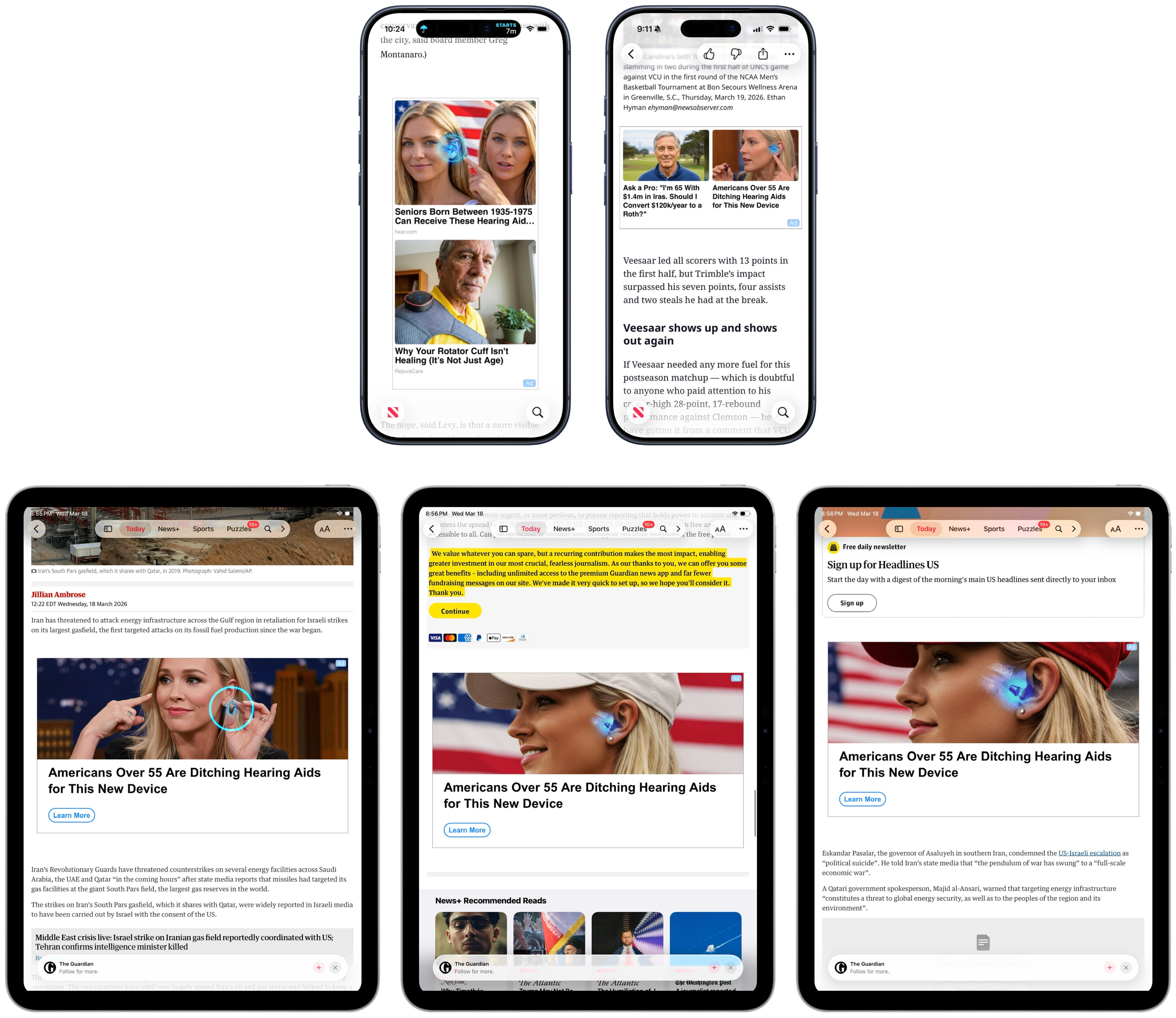
Some of [Cook’s letter] remains true, but has lost some truthiness — and truthiness matters. But some of it is no longer true, period. It’s no longer just “one small part” of Apple’s business that serves advertisers. Here in 2026, search results in the App Store not only show paid ads — frequently for casinos — but the search results are visually dominated by paid ads now that Apple has added a second ad to results. Apple News+ is a paid subscription that offers a genuinely great value for the number of paywalled publishers whose content it includes, but articles on the News app tend to include the weirdest AI-generated ads on the Internet. (How many young blond women am I supposed to believe need hearing aids?) And — at this writing, still “coming soon” — Apple is launching ads on Apple Maps. Apple Maps remains free of charge to use, so according to Tim Cook, we’re not the customer. We’re the product. Or, if you prefer, our frustration is the product.
[…]
The ratio of ads to organic results in App Store search — especially when measured in screen area — is clearly not aligned with Cook’s 2014 statement that “Our software and services are designed to make our devices better. Plain and simple.” Obviously not. App Store search today is designed primarily to generate more revenue for Apple. That’s not criminal, but it’s a change.
[…]
What gave Tim Cook’s privacy letter heft in 2014 wasn’t just the clarity of its plain language, but the fact that you didn’t have to take his word for it that the ads Apple showed you respected your privacy, because Apple didn’t show you ads in 2014. Apple today can’t say that.
[…]
John Ternus should return Apple’s privacy policy to its 2014 clarity. The trust Apple would earn from such a move would far out-value whatever revenue these ads pad to their already hefty and ever-increasing quarterly Services numbers.
I wish that were the case, but I fear this is kind of a Hotelling’s Law situation, where Apple can get most of the benefit by being just slightly better on this axis. Where else do its customers have to go?
In the second fiscal quarter of 2018, services generated $9 billion in revenue (net sales), whereas in Q2 2026, that amount had grown to $31 billion! In this blog post, I want to focus on understanding the relative financial importance of products and services for Apple.
[…]
In 2025, services were 42% of Apple gross margin. How does 26% of net sales become 42% of gross margin? The explanation is that services have a much lower cost of sales. The products gross margin was 37% of products net sales, while the services gross margin was an astonishing 75% of services net sales. In other words, Apple services are almost pure profit!
Does this 75% account for TV and movie production costs?
With persistent general inflation, consumers do not have unlimited money to spend on Apple products. At least in the near future, it’s reasonable to question how much further room is available for growth in profits from Apple products. To satisfy the demands of investors, Apple executives including CEO-elect John Ternus may be forced to rely even more than before on growth in services, which do not face as much pressure on cost of sales as hardware products.
Previously:
- Apple Services Price Hikes 2026
- Apple Hardware Price Hikes
- App Store Personalized Recommendations and Keylogging
- Apple’s Q2 2026 Results
- A Letter to John Ternus
- Ads in Apple Maps
- Blurring App Store Ads and Search Results
- Apple Services in 2025
- More App Store Ad Spots
- Apple Services Price Hikes
- Nowhere Else to Go
3 Comments RSS · Twitter · Mastodon
If only Apple could have remained a company that sold good computers with their own good operating system at a reasonable profit that kept them running comfortably, rather than having to keep making more profit year after year in a predictable pattern that requires them to eventually cannibalize their customers and eventually their whole business. Then *maybe* they may not have felt the need to do this nonsense.
Sacrificing brand, reputation, platform, and user experience for a short term stock boost. This is one of the stupidest, tackiest outcomes. Rent-seeking Services are antithetical to Personal Computing and ownership.
Tim as CEO has been a mistake. Yes he's done some good, but overall he's not done great. Someone else could've done that good without the bad.