EU Antitrust Fines for Google Search and Play Store
Google was today fined €890 million ($1 billion) by the European Union for breaching antitrust rules with regard to its search and Google Play store services.
The European Commission found that Google had broken the Digital Markets Act (DMA) by using its dominant position in the search market to favour its own services, like shopping and hotel deals, over those of rivals.
The Commission also said that the company had abused its position by preventing developers from directing users to cheaper ways to buy apps and app subscriptions on websites and alternative app stores.
The Commission noted that Google has begun testing changes to how its own services are placed in search results and rolled out changes to its steering terms, which the EU’s main executive body described as substantial progress towards compliance.
“Google has fallen short of effective compliance with the Digital Markets Act, and today we have taken decisive yet balanced enforcement action sanctioning these breaches,” said Teresa Ribera, Executive Vice-President for Clean, Just and Competitive Transition.
“The best products should succeed because they’re better, not because they’re owned by the company running the search engine. And European consumers have a right to be told by app developers where to sign up to the best offers, even when the app store owner does not get a cut.”
With search, Google is required to share with competitors — search engines and AI chatbots alike — a massive amount of user data from Google Search user interactions. What terms people search for, what they click on in results, what languages and devices they use. It’s all ostensibly anonymized but that’s tricky when it comes to search terms. A lot of the terms people type into web search fields are to some degree personally identifying. The EC seems to be saying it’s Google’s problem to filter out things like passwords and usernames and omit them from the shared datasets. Google can charge money for this access, but only under “fair, reasonable, and non-discriminatory (FRAND)” prices, based on a Commission-defined methodology.
Previously:
- Google Loses Final EU Antitrust Appeal
- Android AI Violates DMA
- DMA Compliance: Google
- Lower Google Play Store Fees and Registered App Stores
Update (2026-07-27): John Gruber:
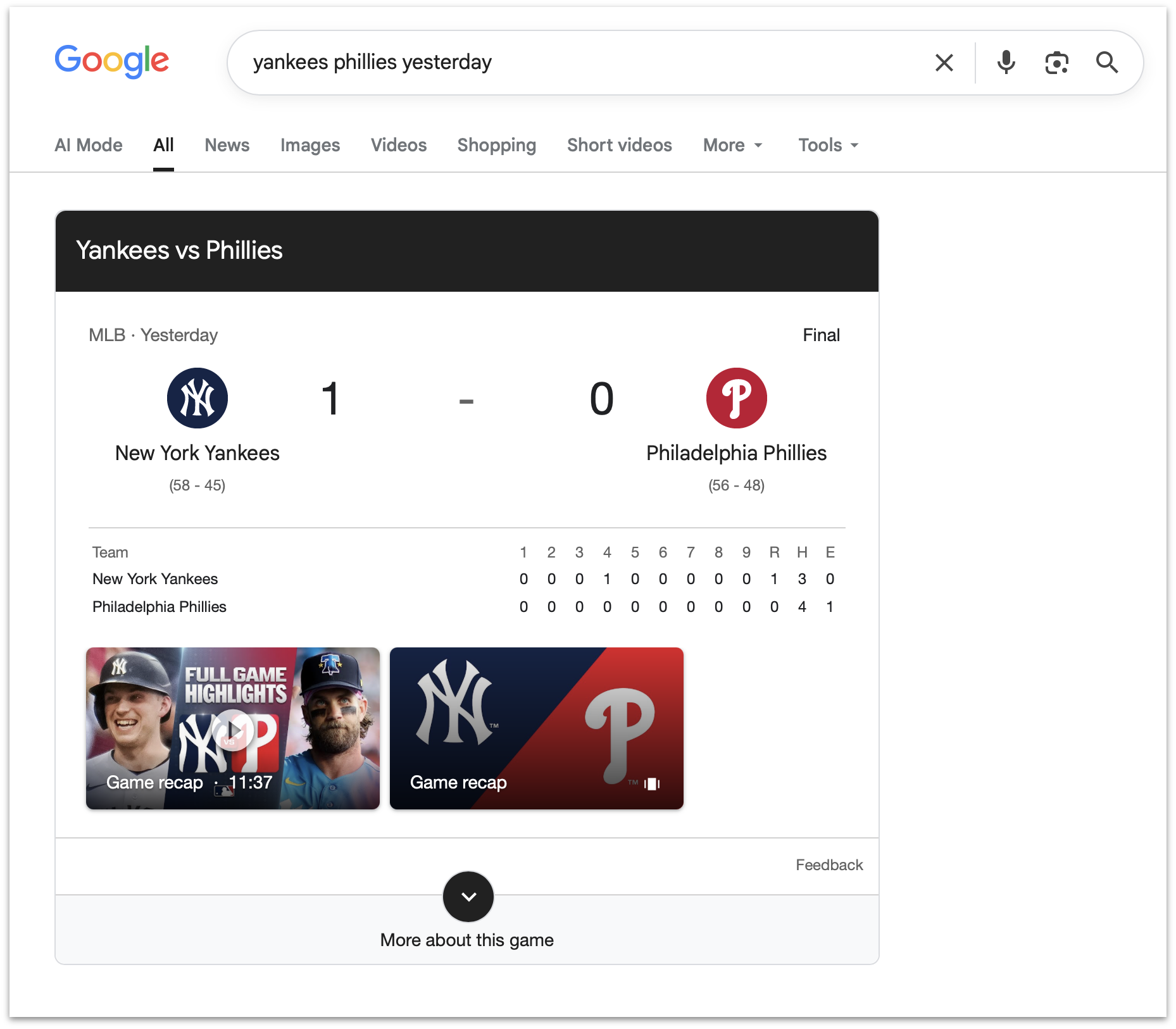
So if you search for the score of a sporting event, it’s illegal in the EU for Google to show you the score, like this search I just tried. What the EC is saying is that because Google Search is so popular, it’s no longer allowed to improve.
It drives me insane when in Europe the link between Google Search and Google Maps is broken and I often have to copy paste an address between the two. Thanks EU, what if I like Google’s integrations?
They could have simply added a selector when a user first clicks on the maps preview in the search result, and then remembered it on device or across that user’s account.
But of course, then the user could choose a competitor’s product and Google would have to honor it. That would be horrible, so instead they just made the user experience worse for everyone and elegantly made people blame the EU.
See also: Hacker News.
15 Comments RSS · Twitter · Mastodon
@DJ: Because....?
I'm asking because I think we agree. At least if you mean anything like it isn't worth the effort, time, and money. (Read: corporate profit.) Please do not try to think this is political - it always is! But the only way to win an argument isn't to post a 10 word comment (if I'm correct EU in your comment can be considered one word) without some kind of explanation of *your* reasons.
If I read your short comment correctly - and I consider the (relatively) small profit these two billion (trillion?) market cap companies make worldwide, they still make a sizable percentage in the EU - something I think both you and I would love to have the EU come after us for.
I thick this is great news. I want competition. I'm against runaway leader monopolies.
I'd love to see them leave.
@Dave: It sounds like we agree. "The juice isn't worth the squeeze", as they say.
The EU apparently expects that they can decree that these companies are "gatekeepers", and that they should just roll over and do what they're told. It's like Google and Apple are the only two bakeries in town, and each is extremely well known for their uniquely shaped cakes. Each has spent years developing their own special cake pans and their own secret recipes for cakes, and now almost everyone who wants cake buys either an A-Cake or a G-Cake (but not both -- they're not cavemen). Both bakeries have accepted that some people want various kinds of sprinkles on their cakes, but neither has the resources to make all those sprinkles, so they let outside sprinkle shops (sprinklers) make all the sprinkles. (At first they could only sell the sprinkles through the A- or G-Bakery stores, but that's a story for another time.)
The sprinklers aren't happy though. Some of them want to put sprinkles between the cake layers, or mix them into the batter. The sprinklers in one region complain to the regional baking authority (RBA). The RBA agrees with the sprinklers and says it's not fair that A- and G-Bakeries make the only cakes that people want, so both bakeries must share their secret cake recipes with the sprinklers, along with all of the data on who's buying the cakes and what they're using the cakes for.
The bakeries are not happy: "But some of the sprinkles taste like onions, or stinky cheese! And at least one of the sprinklers thinks it would be funny to use laxatives in their sprinkles!"
"Too bad for you.", says the RBA. "But you can keep making cake pans."
A- and G-Bakeries could spend a lot of time trying to make pans that can detect and neutralize laxatives and other foul ingredients, but they don't know if the RBA will even allow that. Or, they could stop selling cakes in that region and tell the RBA to pound sprinkles.
That's... at least 10 more words. ;-)
> The EU apparently expects that they can decree
> that these companies are "gatekeepers", and that
> they should just roll over and do what they're
> told"
That's such a peculiar thing to say. They don't just expect that; they literally can.
"The US apparently expects that they can decree that I can't rob banks and that I should just roll over and do what I'm told."
Yes. That's generally how laws work.
Yeah, bank robbery is exactly the same as product development. Clearly, I should have thought of that.
You do understand the point I made, right? You're just intentionally misrepresenting what I said? Because I can't believe you don't understand a simple analogy, particularly because I spelled out exactly what the analogy was about in the next line.
But in case it was unclear, let me try to be as explicit as I possibly can:
The EU makes laws. Companies operating in the EU must follow these laws. If they do not follow these laws, the EU can enforce them.
So saying something like "The EU apparently expects that they can decree that these companies are "gatekeepers", and that they should just roll over and do what they're told" is completely absurd.
Do you understand what I'm saying now?
Oh, I understood you before. I just think you’re over-generalizing. "A law is a law."
The EU is, of course, able to pass whatever laws it wants. "And you don't need to upgrade your cake pans to block laxative sprinkles, because no one is going to do that, so no need to stop them!"
Apple, Google, etc. will have to comply with EU law if they want to sell in the EU. They could comply by rolling over, and whatever happens, happens. Participation trophies for all! They could also comply by diluting their product offerings in the EU, because it's still fair if nobody can do x/y/z, including Apple and Google. Or they could pull out of that market completely, and tell the EU to pound sprinkles. Er... sand.
> Oh, I understood you before
Then why, in the lord's name, did you write that comment pretending I said DMA violations were the same as bank robbery? They're obviously much worse, since bank robbery affects very few people, but everybody in the EU suffers from Apple's and Google's DMA violations.
> Participation trophies for all!
What in the world are you even talking about? How is following a law giving participation trophies to everyone? I mean, I wish it were; I follow laws, but I never get any trophies for it, so in my opinion, neither should Apple and Google. They should just fucking do it, like the rest of us.
As you point out, they absolutely have the option of just leaving the EU if they don't like the laws.
Murder usually affects fewer people than bank robbery, but is a worse crime than bank robbery, and far (far, far, far, ...) worse than DMA violations. But if you insist on measuring by the number of affected people, I'd say that "everybody in the EU suffers" is a gross overstatement. I'd bet that the number of EU people who would be just fine with Apple and Google *not* having to open up their platforms under the DMA is above 99 percent.
"I'd bet that the number of EU people who would be just fine with Apple and Google *not* having to open up their platforms under the DMA is above 99 percent."
If you mean that they aren't aware of the problem and therefore don't care, then sure. If you mean that they don't benefit from the DMA, then I disagree.
When (American) people say "AmericanCompany should just leave the E.U. rather than obey the law", like it's an easy option and the E.U. is more trouble than it's worth, I often wonder how many of them understand that the E.U. has a larger population than the USA.
"So if you search for the score of a sporting event, it’s illegal in the EU for Google to show you the score, like this search I just tried."
No, it's not. That's a lie.
"What the EC is saying is that because Google Search is so popular, it’s no longer allowed to improve."
No, they're saying that Google can't give its own services preferential treatment. But Google would rather not provide this feature at all than allow third parties to get top billing in a search result, so they chose to remove the feature instead.
That's 100% Google's decision, and by blaming the regulation for Google's behavior, Gruber is doing exactly what Google hopes people would do.