AP (Hacker News):
A federal judge has approved a $1.5 billion copyright settlement in which artificial intelligence company Anthropic will pay thousands of authors about $3,000 per book after using pirated copies of their works to train its Claude chatbot.
[…]
Bestselling thriller novelist Andrea Bartz first brought the suit with two other authors in 2024. It’s the first major settlement in dozens of AI copyright lawsuits that are still working their way through courts.
Dare Obasanjo:
Somewhat ironic given recent claims from Anthropic about others training their AI on its work.
Previously:
Anthropic Artificial Intelligence Claude Copyright Lawsuit Legal Web Crawlers
Tim Hardwick (Wired):
Google was today fined €890 million ($1 billion) by the European Union for breaching antitrust rules with regard to its search and Google Play store services.
The European Commission found that Google had broken the Digital Markets Act (DMA) by using its dominant position in the search market to favour its own services, like shopping and hotel deals, over those of rivals.
The Commission also said that the company had abused its position by preventing developers from directing users to cheaper ways to buy apps and app subscriptions on websites and alternative app stores.
Sergiu Gatlan:
The Commission noted that Google has begun testing changes to how its own services are placed in search results and rolled out changes to its steering terms, which the EU’s main executive body described as substantial progress towards compliance.
“Google has fallen short of effective compliance with the Digital Markets Act, and today we have taken decisive yet balanced enforcement action sanctioning these breaches,” said Teresa Ribera, Executive Vice-President for Clean, Just and Competitive Transition.
“The best products should succeed because they’re better, not because they’re owned by the company running the search engine. And European consumers have a right to be told by app developers where to sign up to the best offers, even when the app store owner does not get a cut.”
John Gruber (Mastodon):
With search, Google is required to share with competitors — search engines and AI chatbots alike — a massive amount of user data from Google Search user interactions. What terms people search for, what they click on in results, what languages and devices they use. It’s all ostensibly anonymized but that’s tricky when it comes to search terms. A lot of the terms people type into web search fields are to some degree personally identifying. The EC seems to be saying it’s Google’s problem to filter out things like passwords and usernames and omit them from the shared datasets. Google can charge money for this access, but only under “fair, reasonable, and non-discriminatory (FRAND)” prices, based on a Commission-defined methodology.
Previously:
Update (2026-07-27): John Gruber:
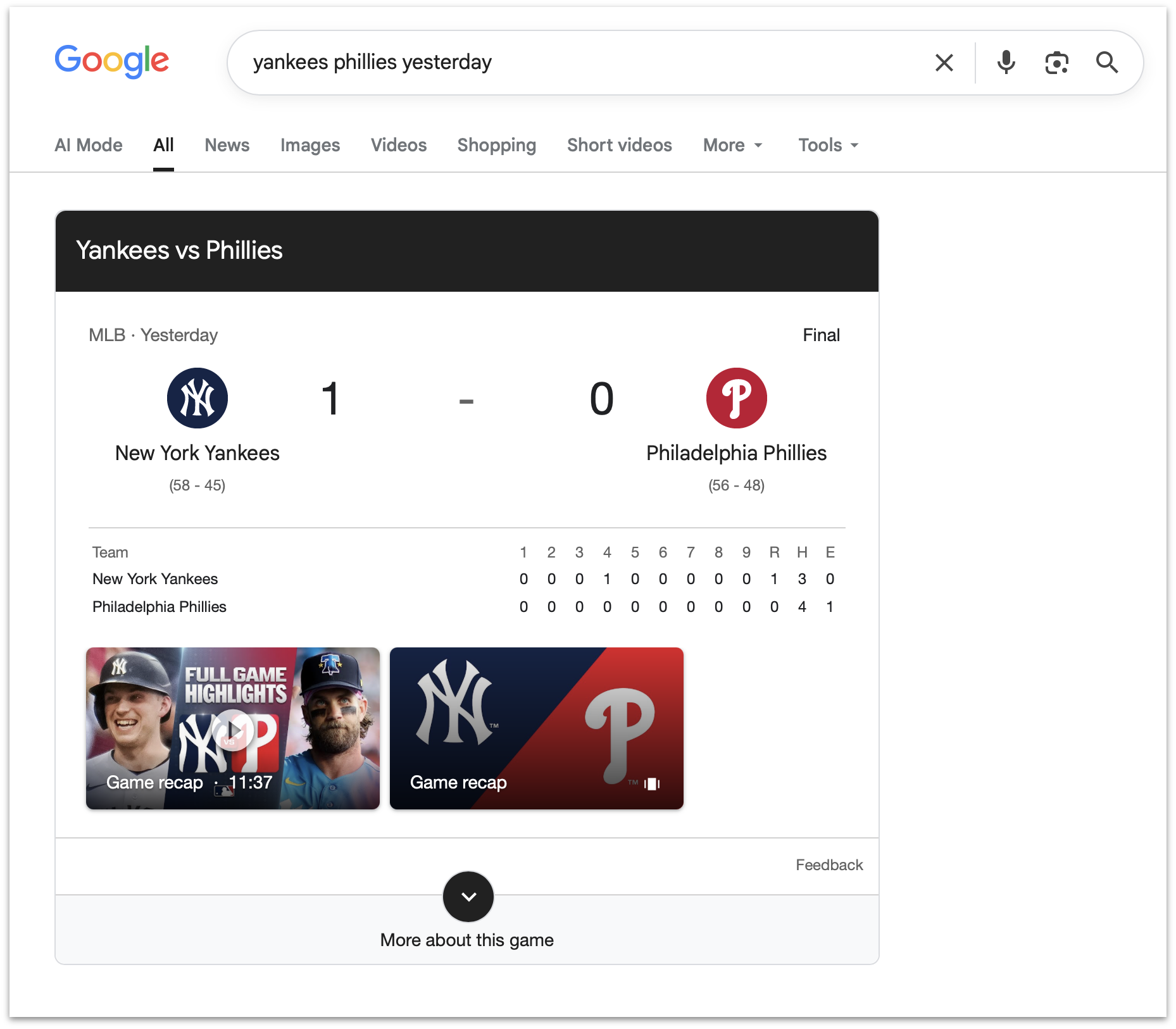
So if you search for the score of a sporting event, it’s illegal in the EU for Google to show you the score, like this search I just tried. What the EC is saying is that because Google Search is so popular, it’s no longer allowed to improve.
plantain:
It drives me insane when in Europe the link between Google Search and Google Maps is broken and I often have to copy paste an address between the two. Thanks EU, what if I like Google’s integrations?
phiresky:
They could have simply added a selector when a user first clicks on the maps preview in the search result, and then remembered it on device or across that user’s account.
But of course, then the user could choose a competitor’s product and Google would have to honor it. That would be horrible, so instead they just made the user experience worse for everyone and elegantly made people blame the EU.
See also: Hacker News.
Antitrust Digital Markets Act (DMA) European Union Google Google Play Store Google Search Legal
Ryan Whitwam (PDF, Reddit):
Back in 2018, Google was handed a record-setting 4.34 billion-euro ($4.9 billion) fine in Europe for abusing its monopoly on Android. The company has spent the intervening years challenging that decision, but the continent’s highest court has put a stop to that. The Court of Justice of the European Union has affirmed the penalty, meaning Google is out of options.
[…]
The EU took issue with Google search and Chrome being the default options on Android. Even devices made by other companies, such as Samsung and Xiaomi, include Google apps as the default per the Android licensing agreement, giving Google an unfair advantage, according to European antitrust regulators. This is not to be confused with a 2.95 billion euro ($3.45 billion) fine against Google’s advertising monopoly issued by the European Union last year.
Arjun Kharpal:
In 2022, a lower EU court reduced the fine to the current 4.1 billion euros from 4.34 billion euros previously.
Google has argued that the Android operating system provides choice for users and supports developers and businesses across Europe.
Via John Gruber:
Google last year booked $132 billion in profit; this fine is about 3 percent of that..
[…]
There’s never a reason not to string the appeal process out, but it’s especially true when your profits are growing at an exceptional rate. By growing their profits around 5×, they’ve reduced the relative sting of this fine by 5×
Previously:
Android Antitrust Business European Union Google Google Chrome Google Search Legal
Marcus Mendes:
Apple’s requests to overturn a $634 million patent verdict and secure a new trial in its long-running legal battle with Masimo were denied.
Wesley Hilliard:
There doesn’t appear to be any other path for appeal or recourse, as the judge rejected both requests for either a new judgement or trial.
[…]
In the end, Masimo didn’t succeed in getting the Apple Watch banned or fundamentally redesigned. It won an empty victory with the funds it will be paid, and the patents affecting the lawsuit will expire in 2028 and 2029 anyway.
Paul Terpstra:
Although the ruling confirms the financial penalty, it does not affect current Apple Watch users. The smartwatch’s blood oxygen monitoring feature remains available after Apple introduced a software update in January 2024 that allowed sales to continue despite earlier legal challenges.
Previously:
Apple Apple Watch Lawsuit Legal Masimo Patents