Marcus Mendes:
Apple today filed a request with the Supreme Court in an attempt to reverse key lower court rulings over the App Store injunction in its long-running legal battle with Epic Games.
[…]
In its petition, Apple is asking the Supreme Court to review two questions.
The first is whether Apple should have been held in contempt for charging a commission on purchases made outside the App Store.
The second is about the scope of the injunction.
Sarah Perez:
“Epic never brought a class action and never attempted to show that enjoining Apple’s conduct against all other developers — like Microsoft or Spotify, who have nothing to do with Epic — was somehow necessary to provide relief to Epic,” reads Apple’s new petition, which asks the U.S. Supreme Court to review the lower court ruling.
In the same document, Apple also argues against the Ninth Circuit’s civil contempt order over Apple’s compliance with the injunction. The court had ruled that Apple must give developers the right to include links in their apps — links that could direct users to alternative payment options outside of Apple’s own system — if they chose to do so. Apple did permit this as required, but charged fees on those outside purchases, leading to the contempt order.
John Gruber:
Apple’s argument here is that only the letter of the law matters, and the letter of the injunction did not say anything about charging commissions on external payments, and thus they can’t be held in contempt for violating something that was never spelled out explicitly.
Wesley Hilliard:
If Apple wins the “in spirit” portion of its arguments, Apple gets to carry on with its previous 12% and 27% commission rates for external linking. It would also mean proceedings in the lower courts would return to appeals stages.
Juli Clover:
Epic Games and Apple agreed to an expedited schedule and Apple’s petition will be considered on June 25. Apple expects a decision on whether the Supreme Court will hear the case by the time the justices recess for the summer in late June or early July.
Previously:
Update (2026-06-11): Hartley Charlton:
Epic filed a 35-page opposition on June 4, 2026, urging the Supreme Court to reject Apple’s appeal. Apple’s response takes aim at two central arguments Epic made in that filing.
On the question of anti-steering, Apple says Epic is mischaracterizing the scope of the injunction against it. According to Apple, the order only restricted specific anti-steering practices and did not address App Store commissions, making Epic’s framing an attempt to rewrite the ruling rather than an accurate description of it.
The second dispute involves a 2025 Supreme Court precedent, “Trump v. CASA, Inc.” Epic says Apple is wrongly claiming an exemption from it. Apple responds that the earlier ruling explicitly states CASA “has no bearing” on antitrust cases, which this is, making Epic’s argument moot.
Update (2026-09-17): Juli Clover:
Apple today filed its opening merits brief with the Supreme Court as it prepares to fight the contempt ruling that forced it to change its App Store rules. Apple is asking the Supreme Court to reverse or vacate the contempt order, which would return the App Store to its pre–2025 rules.
Antitrust App Store Apple Epic Games External iOS Payments Fortnite iOS iOS 26 Lawsuit Legal
John Gruber:
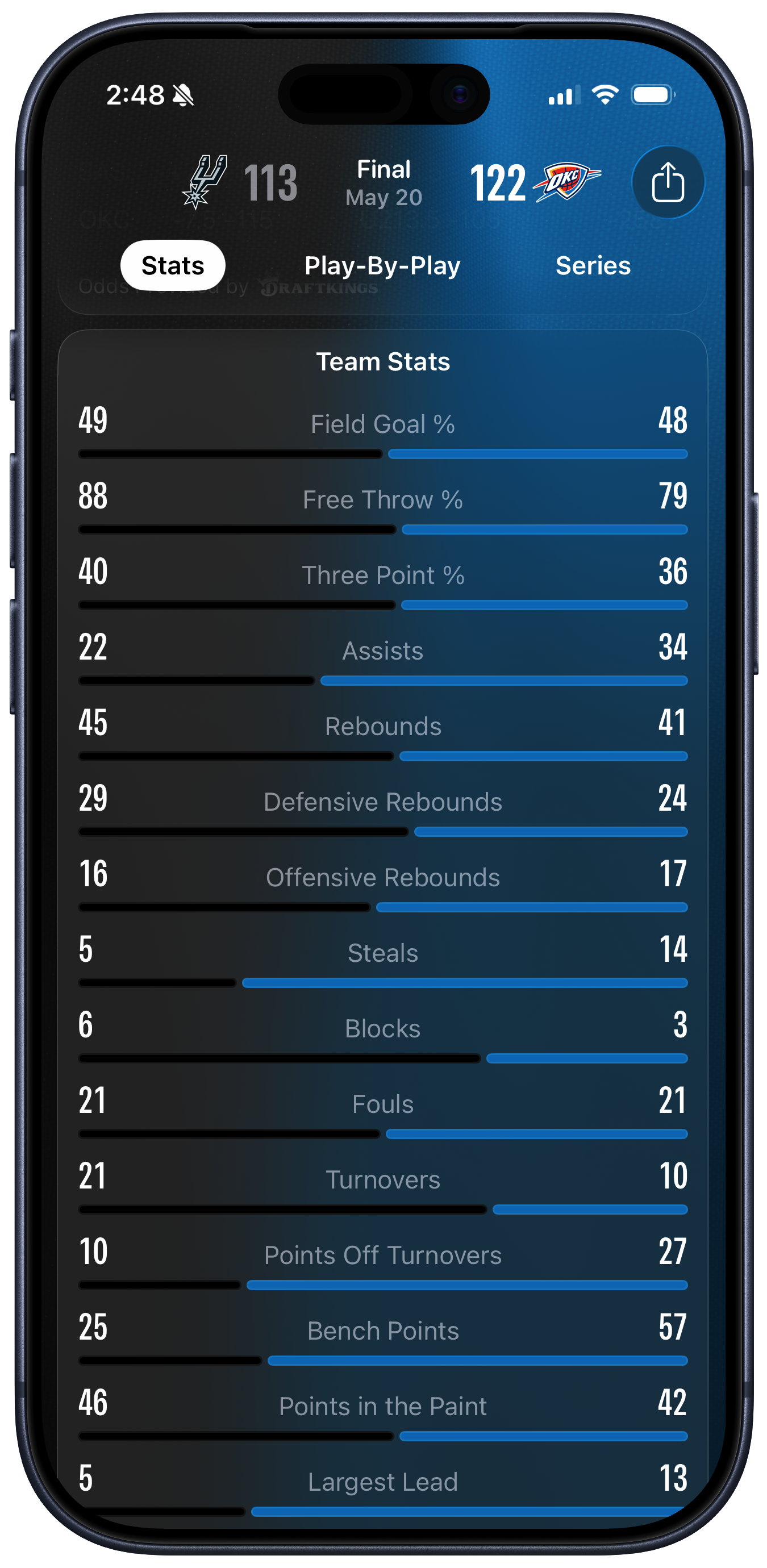
I’ve got some gripes about certain specific aspects of Apple Sports. Like, where does one even start to explain how much is wrong with their zero-sum visualization of team stats? Has anyone ever even seen a presentation like that before?
It has to be seen to be believed. What on earth were they thinking?
Still kind of curious that Apple Sports remains iPhone-only — not even an iPad version — but in a way I find that charming too. Maybe Apple is tight on money?
Kieran Healy:
John is right to call the picture a “Zero Sum” representation. The design strongly suggests to the viewer that, within each row, we’re looking at each team’s share of a total. Each pair of black and blue lines seem to be vying for control of their whole row, with the longest line being the “winner” in each case.
[…]
Literally none of the measures in the Basketball data above are zero-sum in this way. Both teams could shoot 100% from the free throw line, or zero percent. But because the first three measures shown are percentages, this reinforces the zero-sum impression given by the lines. It certainly did that in my case. But then, starting with Assists, the remaining rows are just absolute numbers. When I started looking at the absolute numbers, I got confused a second time by the length of the lines. “Oh so it’s not a share, it’s the value” I thought—but no, they do correspond in terms of relative proportions to the teams share within each row. But they’re not really shares they’re just magnitudes. But they have to be shown in a fixed space and we want to make them relatively comparable somehow so … Argh.
Apple’s software design right now seems to love uniformity. Throw a bunch of disparate statistics—or system settings—in a big list. It looks superficially clean and is easy to code. It seems like there’s a chart that’s illuminating the results, but it’s actually worse than a traditional text-only box score. The numbers that you most want to compare are placed maximally far apart. It’s like reading a table of contents with dual-colored dot leaders, but of course in a table of contents you aren’t meant to be reading all the page numbers.
Our fundamental problem is that we just have two cases (the teams) and fifteen different measures, or variables. Each variable, except for the three percentages, is in effect on its own scale. There’s no direct way to make comparisons across them.
John Gruber:
The problem is further complicated by the fact that Apple Sports shows the same screen for all sports, just with different sport-specific stats. I think the solution is to just present these numbers in a table. Yes, tables are boring. But they’re not confusing. What Apple Sports is doing, in an attempt not to be boring, is confusing.
Previously:
Apple Sports Design iOS iOS 26
MathWorks (Hacker News, Reddit):
Cleve was chief mathematician and cofounder of MathWorks and the author of the first version of MATLAB.
In his early years, he was a professor of math and computer science for almost 20 years at the University of Michigan, Stanford University, and the University of New Mexico. During this time he was known for being one of the authors of LINPACK and EISPACK, two foundational Fortran libraries for numerical computing. One popular paper of his is “Nineteen Dubious Ways to Compute the Exponential of a Matrix.”
He is coauthor of three traditional textbooks on numerical methods and author of two online books, Numerical Computing with MATLAB and Experiments with MATLAB.
Wikipedia:
Before joining MathWorks full-time in 1989, he also worked for Intel Hypercube, where he coined the term “embarrassingly parallel”, and Ardent Computer Corporation.
Education Fortran Mac Mac App Math MATLAB Programming Rest in Peace