Ads in Apple Maps
Apple is “exploring” the idea of showing search ads in the Apple Maps app, according to Bloomberg’s Mark Gurman.
[…]
Ads in the Apple Maps app would not be the traditional banner ads that you see on websites, but rather paid search results. For example, a fast food chain could pay Apple to appear near the top of the results when a user searches for “burgers” or “fries.” Many similar apps already offer search ads, including Google Maps, Waze, and Yelp.
If a company has maxed out what they can earn through hardware and software quality then other screws need to be tightened.
[…]
I think this is important to consider as a third-party developer.
It used to be that hardware sales driven by the software platform were Apple’s best path to growth. Writing software for that platform added value to that platform: third-party developers were contributing to the flywheel.
Now, service revenue is the best path to growth. Writing software for the platform does not contribute to service revenue and can’t move the needle on selling more hardware. It is a maintenance-level concern.
Apple has officially announced that ads are coming to the Apple Maps app on the iPhone and iPad in the U.S. and Canada starting “this summer.”
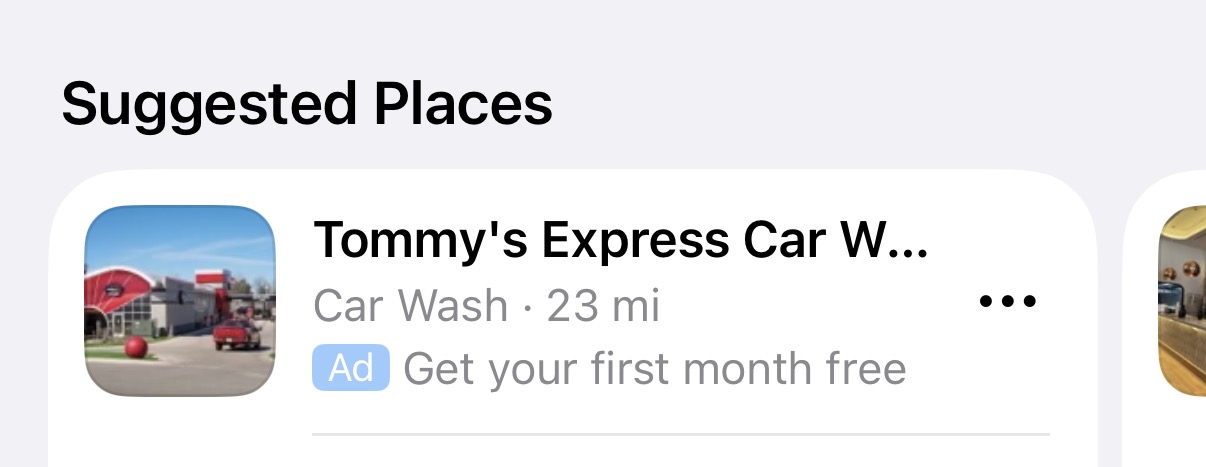
Apple says businesses in the U.S. and Canada only will be able to place ads in search results and at the top of a new “Suggested Places” section in the app.
[…]
Similar to the ads that are already shown in App Store search results on the iPhone and iPad, ads in Apple Maps will have an “Ad” label, and Apple promises strong privacy protections. For example, Apple says a user’s location and the ads they see and interact with in Apple Maps are not associated with a user’s Apple Account.
The way they are “clearly marked” is with a light blue background and a small “Ad” badge, though it is worth noting Apple has been testing an even less obvious demarcation for App Store ads. In the case of the App Store, I have found the advertising blitz junks up search results more than it helps me find things I am interested in.
This is surely not something users are asking for. I would settle for a more reliable search engine, one that prioritizes results immediately near me instead of finding places in cities often hundreds of kilometres away.
Is it me or does iPhone’s iOS Maps app not show the details when using its offline map like in Bozeman, MT, USA? Like searching for its airport, restaurants, stores, etc. This is in an old iPhone 11 Pro Max’s iOS v17.6.1. I tested with airplane on to disable both cell and wifi to test out the newly downloaded offline 1 GB map area.
I’ve found that it works much worse than Google Maps when offline. It won’t find directions, and even maps that I’d preloaded don’t always display.
I could continue, and certainly for other location types beyond restaurants, but I believe I’ve made my point: every new Apple Maps partner merely adds another incomplete layer of data. The underlying problems persist because Apple relies on these external sources rather than genuinely investing in its own internal ratings, reviews, or photo capabilities. As such, their data remains largely unhelpful.
The Michelin Guide, The Infatuation, or any “expert” source will never cover every restaurant in every city. As for user reviews, OpenTable users are limited by its business model, and both Yelp and TripAdvisor offer more features and consistency in their own apps than Apple provides in Maps.
Google Maps, however, offers a one-stop shop for ratings, reviews, menus, reservations, and even real-time busyness data, all directly comparable to surrounding places and usable worldwide.
Ingrid Burrington (via Nick Heer):
Google Maps probably isn’t profitable. At best, I would believe it’s been marginally profitable in recent years.
[…]
There’s an oft-cited 2019 research note from a Morgan Stanley analyst that estimated that Maps revenue would be around $2.95 billion in 2019, and could reach $4.63 billion and $11 billion in 2023 based on new advertising programs for Maps that the company planned to grow out. I haven’t found the original research note anywhere online, just coverage of it. These estimates have been passed around enough online that today SEO-hungry slop blogs confidently state that in 2023 Maps made $11 billion.
“Some older software versions will no longer support Apple Services like the App Store, Siri, and Maps,” said Apple, in a support document published last month. “Update your software to the latest available version to continue using these services.”
I just did another round of “what’s making my Zoom calls stutter every 60s” and this time the culprit was… APPLE #!*$ING MAPS. That’s right, Macs now come preloaded with software to ruin wifi latency :(
You can fix by revoking Maps’ location access in Preferences[…]
Previously:
- Apple Business
- MacBook Neo
- Choosing a Driving Route in CarPlay
- More App Store Ad Spots
- Our Changing Relationship With Apple
- Glowtime Ennui
- Apple Maps on the Web
- Apple Maps in Sequoia and iOS 18
Update (2026-03-30): John Gruber:
I can’t help but suspect that they’re going to make the experience worse, and the question is really just how much worse. The addition of ads to the App Store has made the experience worse.
[…]
I also do not begrudge Apple for wanting to monetize Maps. But if the addition of ads does make the Apple Maps experience worse, why won’t Apple let us buy our way out of seeing them? Netflix doesn’t force us to watch their ads. YouTube Premium is arguably the best bang-for-the-buck in the entire world of content subscriptions. Why should Apple One subscribers still see these ads in Apple Maps?
I know that it’s not the same team doing all of these things, so that doesn’t mean that the ad team in Apple Maps is going to compromise the experience exactly like the team in iMessage, and the team in Wallet. It’s precisely because these garbage experiences are distributed across teams that makes me think it’s impossible to ever have a good experience when Apple’s financial interest is ahead of my own.
Update (2026-05-07): Apple (via Hacker News):
If an Apple Account is registered to a minor under 13 years of age or set up as an educational Managed Apple Account, we use on device logic to not display ads.
[…]
Information about the ads you view or tap is tied to a random identifier that rotates multiple times per hour. This means Maps can’t search for information about you based on an identifier linked to you or your device. Longer-lived identifiers are used for application performance, aggregate usage metrics, and to maintain the integrity of the service. These longer-lived identifiers are not attached to your Apple Account or other information that might identify you.
Previously:
Update (2026-08-26): Stephen Robles:
Courage
Update (2026-08-28): Ryan Christoffel:
There are two places you’ll find ads in the Maps app:
- Before searching: Suggested Places in the search screen will feature an ad.
- After searching: Ads will appear in search results when relevant.
This time I saw an ad for Tommy’s Express Car Wash (“Get your first month free”), 23 miles away in the middle of a suburban shopping mall. Apple Maps estimates it would take me 1 hour 8 minutes to drive there right now. I’ll get right on that.
The first organic (non-ad) suggested place is a coffee shop 300 feet away.
5 Comments RSS · Twitter · Mastodon
> I’ve found that it works much worse than Google Maps when offline.
I've experienced the opposite. When I use offline maps, Apple Maps usually has much more complete data than Google. The download sizes for Apple's offline maps are also 2-3x larger than Google's for a similar area.
That said, Apple's business info still doesn't come close to matching Google's, as others have mentioned. They'd need to build up a social team to have a chance at getting reviews, photos, etc., and that's not in their DNA.
I feel like brands either get one or the other: they charge more for “premium” and a better experience (which definitely should mean ad-free), or they don’t and then the ads are the price. Too many things lately are trying to double-dip, e.g. streaming services that are mostly ad-free but still find ways to shove stuff in. Stop it!
I have previously expressed feedback to Apple that their brand is literally being tarnished by these games. I also specifically mentioned that I am considering making my M1 my last Mac, since they care most about hardware sales. I suspect all Apple feedback goes into a void but I can hope.
Wouldn't it have been nice if, instead of endless growth, Apple could just make something great, keep it that way, and then continue to be profitable, just not necessarily more profitable than the previous year?
This trend is irreversible. Apple will only get worse over time. We liked them way better five years ago than we do today. We will hate them much more five years from now.