Caitlin Huston (The Verge, Variety):
In the letter, sent Wednesday, Disney says there has been copyright infringement on a “massive scale,” given its claims that Google has been using AI models and services to “commercially exploit and distribute copies” across many channels, including Google Workspace applications and the YouTube mobile application.
“Google has deeply embedded its infringing video and image AI Services into its broad family of products and services actively used by over a billion people. This multiplies the scope of Google’s infringement, and harm to Disney’s intellectual property, not to mention the ill-gotten benefits Google enjoys from its unauthorized exploitation of Disney’s copyrighted works,” the letter reads.
OpenAI (Hacker News, CNBC, Hacker News):
As part of this three-year licensing agreement, Sora will be able to generate short, user-prompted social videos that can be viewed and shared by fans, drawing on more than 200 Disney, Marvel, Pixar and Star Wars characters.
[…]
Alongside the licensing agreement, Disney will become a major customer of OpenAI, using its APIs to build new products, tools, and experiences, including for Disney+, and deploying ChatGPT for its employees.
As part of the agreement, Disney will make a $1 billion equity investment in OpenAI, and receive warrants to purchase additional equity.
No details on the licensing agreement, but my guess is that, like the Apple-Gemini deal, OpenAI isn’t paying enough to offset the flow going the other way. I thought Disney would want to keep tighter control over their IP, but it seems like they’re using it to buy a lottery ticket.
M.G. Siegler:
So that’s not just a one-two punch, it’s more like a one-two-three-four punch combo. With this last bit being key because Disney is obviously now going to be directly incentivized to favor any work and partnerships with OpenAI.
[…]
So is Disney doing the right thing here? Time obviously will tell, but this is also fairly limited in scope – both time-bound and IP-bound – clearly on purpose. And working with a company to ensure better oversight of IP infractions seems like a better move than simply suing. Sorry, Midjourney, Character.ai, and now Google!
Previously:
Artificial Intelligence Business Copyright Disney Google Legal OpenAI Sora YouTube
Apple:
Apple today announced 45 finalists for this year’s App Store Awards, recognizing the best apps and games across 12 different categories for creating exceptional experiences that inspire users to accomplish more, reimagine their daily workflows, and push creative boundaries.
Confusingly, this is different from the Apple Design Awards, which happen around WWDC. Many of the best Mac apps are not in the Mac App Store and so aren’t eligible for either list.
John Gruber (Mastodon):
I did not enjoy all of them as much as Apple did.
[…]
iPhone app of the year Tiimo bills itself as an “AI Planner & To-do” app that is designed with accommodations for people with ADHD and other neurodivergences. Subscription plans cost $12/month ($144/year) or $54/year ($4.50/month). It does not offer a native Mac app, and at the end of onboarding/account setup, it suggests their web app for use on desktop computers.
[…]
The app seems OK, but not award-worthy to me. But, admittedly, I’m not in the target audience for Tiimo’s ADHD/neurodivergent focus. I don’t need reminders to have coffee in the morning, start work, have dinner, or to watch TV at night, which are all things Tiimo prefilled on my Today schedule after I went through onboarding. As I write this sentence, I’ve been using Tiimo for five minutes, and it’s already prompted me twice to rate it on the App Store. Nope, wait, I just got a third prompt.
[…]
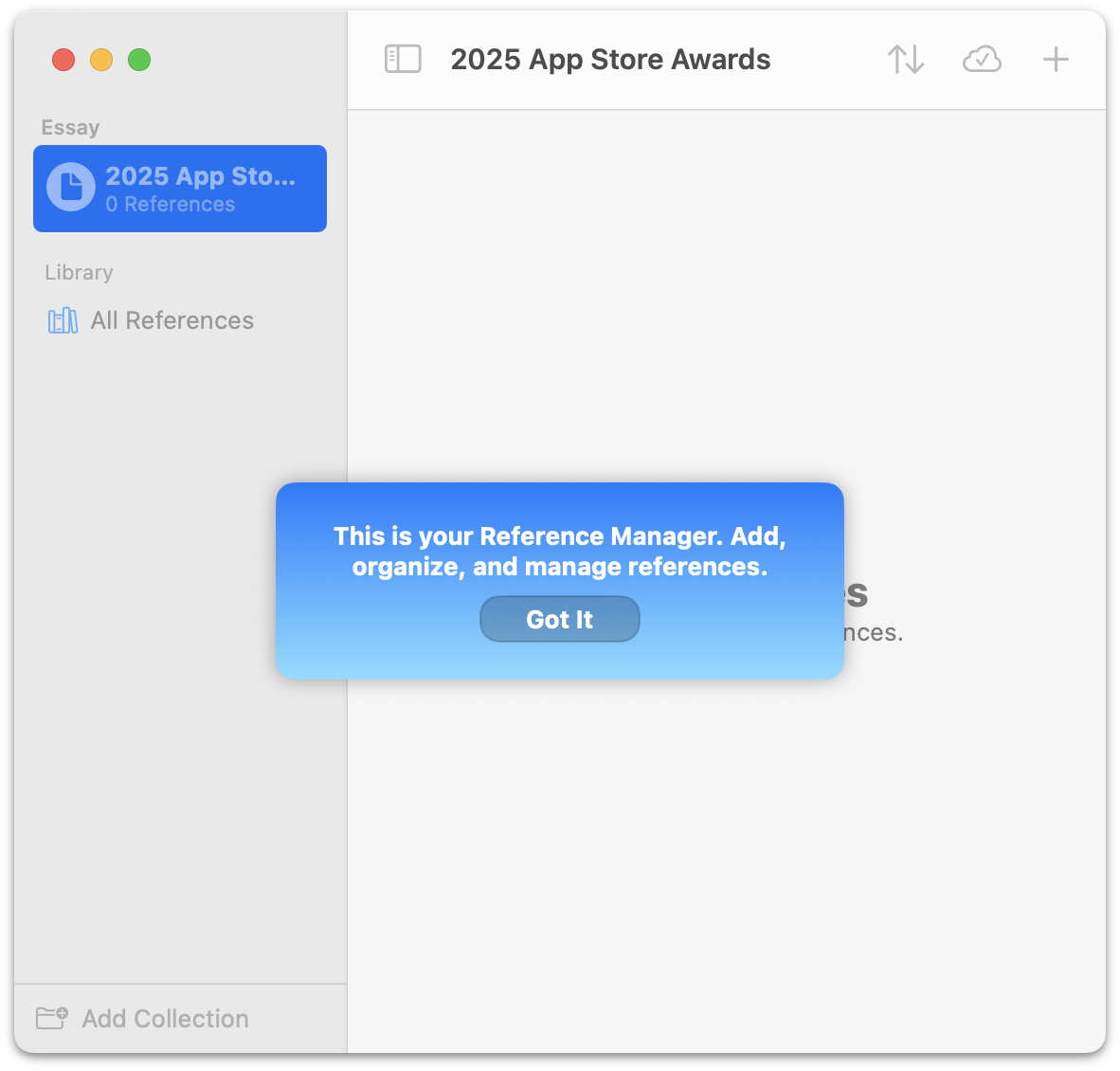
Essayist is a document-based (as opposed to library-based) app, and its custom file format is a package with the adorable file extension “.essay”. The default font for documents is Times New Roman, and the only other option is, of all fonts, Arial — and you need an active subscription to switch the font to Arial.
[…]
The app carries a few whiffs of non-Mac-likeness (e.g. the aforementioned lack of Settings, and some lame-looking custom alerts).
I tuned out the ADAs years ago when Apple kept gushing about how apps that violated all sorts of platform conventions did such a good job of following the human interface guidelines. If you want to see which apps are popular, there are charts for that. These days, I think the awards are mainly useful to see what types of things Apple wants to promote. This year, that included an app with no Mac version and an app that Gruber suspected be Catalyst. Between that and the example Apple’s setting with its own design work, it’s nudging things the wrong direction. It falls to others to set the standard.
Apple:
Explore a new visual gallery to find how teams of all sizes are taking advantage of the new design and Liquid Glass to create natural, responsive experiences across Apple platforms.
Mike Rockwell:
Every single example they show looks worse with Liquid Glass than it did with the previous design language. Poor contrast, distracting translucency — it’s a mess.
Previously:
Update (2025-12-12): Matt Sephton:
Also the Liquid Glass gallery doesn’t have any macOS apps.
App Store App Subscriptions Artificial Intelligence Design Essayist Font iOS iOS 26 iOS App Liquid Glass Mac Mac App Mac App Store macOS Tahoe 26 Tiimo
Adam Engst:
Put simply, an interface shouldn’t make it too easy to perform a destructive action or create more work for you, and inadvertent calls can easily create more work. You may prefer a different behavior than I do, but I hope we can all agree that it’s good to have a choice of whether a tap on a recent call initiates a callback or opens its associated contact.
But isn’t it weird that the way you toggle the tap-a-call behavior is by switching the Phone app’s view? What if you like Unified view but prefer that tapping a recent call starts a callback rather than opening a contact?
[…]
Here’s the odd part: if you switch the Phone app to Classic view and then return to Settings, the Tap Recents to Call switch disappears, and Hold Assist Detection slides up. […] This is deeply wrong. “User interface elements should not come and go based on settings adjusted elsewhere,” said Paul Kafasis, while holding his nose and fanning the air with his hand, in an exaggerated gesture of disgust aimed at Apple.
Previously:
Update (2026-02-02): John Gruber:
I’d argue that Apple used to offer options like this all the time. The Music app on the original iPhone (which app was actually named “iPod” for a while) let you customize all the tabs at the bottom. All of Apple’s good Mac apps (the AppKit ones, primarily) still let you customize the entire toolbar. The problem isn’t that Apple now offers two very different interfaces for the Phone app. The problem is that Apple stopped offering users ways to significantly tailor apps to their own needs and tastes — and the proof that they stopped is that so many people now think it’s so strange that they’re offering two options for how the Phone app should look and work.
[…]
No need to dig two or three levels deep into the Settings app. You can just switch right there in the main screen of the Phone app itself.
I tried the new design for a while, and it’s fine, but I decided I prefer the old, ununified view.
Update (2026-03-03): John Gruber (Mastodon):
Engst really likes this aspect of the Unified view, because the old behavior made it too easy to initiate a call accidentally, just by tapping on a row in the list. I’ve made many of those accidental calls the same way, and so I prefer the new Unified behavior for the same reason. Classic’s tap-almost-anywhere-in-the-row-to-start-a-call behavior is a vestige of some decisions with the original iPhone that haven’t held up over the intervening 20 years. With the original iPhone, Apple was still stuck — correctly, probably! — in the mindset that the iPhone was first and foremost a cellular telephone, and initiating phone calls should be a primary one-tap action. No one thinks of the iPhone as primarily a telephone these days, and it just isn’t iOS-y to have an action initiate just by tapping anywhere in a row in a scrolling list. You don’t tap on an email message to reply to it. You tap a Reply button.
[…]
Engst and I discussed this at length during his appearance on The Talk Show earlier this week. Especially after talking it through with him on the show, I think I understand both what Apple was thinking, and also why their solution feels so wrong.
[…]
There’s a conflict here. You can’t have the two views default to different row-tapping behavior if one single switch applies to both views.
[…]
The confusion would be eliminated if the Classic/Unified toggle were mirrored in Settings. That would make it clear why “Tap Recents to Call” only appears when you’re using Unified — because your choice to use Unified (or Classic) would be right there.
Guy English:
That the phone part of iPhone is so weird and requires esoteric knowledge and a “Classic” switch is bananas.
John called me a few weeks ago and somehow I fumbled the notification, then I tried to call him back and couldn’t work it out, and finally he just called me again.
Design iOS iOS 26 Phone.app