Apple (MacRumors):
Apple today announced that Jennifer Newstead will become Apple’s general counsel on March 1, 2026, following a transition of duties from Kate Adams, who has served as Apple’s general counsel since 2017.
She was previously chief legal officer at Meta and helped write the Patriot Act.
Lisa Jackson, vice president for Environment, Policy, and Social Initiatives, will retire in late January 2026. The Government Affairs organization will transition to Adams, who will oversee the team until her retirement late next year, after which it will be led by Newstead.
It sounds like her position is being eliminated.
Dan Moren:
Newstead will not head up environmental and social initiatives—those will instead transfer to newly installed chief operating officer Sabih Khan, who also picked up some new responsibilities in Giannandrea’s departure. Safe to say he’s going to be very busy; it does suggest that Apple considers its environmental affairs part of its operations pipeline.
See also: signüll.
Dan Moren:
Maybe Alan Dye was traded to Meta for a general counsel and a player to be named later?
John Gruber:
So it’s not just that Alan Dye jumped ship from Apple for the chief designer officer role at another company. It’s not just that he left for a rival company. It’s that he left Apple for Meta, of all companies. Given what Cook has said about Meta publicly, one can only imagine what he thinks about them privately. Apple executives tend to stay at Apple. The stability of its executive team is unparalleled. But Dye is a senior leader who not only left for a rival, but the one rival that Cook and the rest of Apple’s senior leadership team consider the most antithetical to Apple’s ideals.
[…]
How could someone who would even consider leaving Apple for Meta rise to a level of such prominence at Apple, including as one of the few public faces of the company?
[…]
It’s also that it’s now clear that Dye’s moral compass was not aligned with Apple’s either. Tim Cook and the rest — or at least most? — of Apple’s senior leadership apparently couldn’t see that, either.
You could also look at this and the hiring of Newstead as more evidence that Apple’s privacy talk is more about marketing than deeply held ideals. (In fairness, I don’t know what Newstead’s contributions to the Patriot Act actually were—it’s possible she was trying to make it better for privacy.)
Previously:
Update (2025-12-10): John Gruber:
This news yesterday is just typical planned retirements. The timing is slightly unfortunate though. In the eyes of observers unfamiliar with the company, they might be misconstrued as signs of executive upheaval, occurring on the heels of the minor and major dramas of Giannandrea’s and Dye’s departures. The Jackson / Adams / Newstead transitions announced yesterday are nothing of the sort.
[…]
Lastly, I wouldn’t read anything into Newstead coming to Apple by way of Meta.
I agree that the What the heck is going on at Apple? rhetoric is overblown, but the structural changes could be significant. At the least, Newstead brings significant antitrust and regulatory experience from her time at Meta.
Alan Dye Apple Business Environment Legal Privacy Tim Cook
Dominic Preston (Hacker News, MacRumors, Slashdot):
Netflix has announced that it’s struck a deal to acquire Warner Bros. for $82.7 billion. The purchase will go through after Warner Bros.’ planned split from Discovery, now expected to take place in Q3 2026.
[…]
Netflix suggests it has no immediate plans for drastic change at Warner Bros., describing HBO and HBO Max as a “compelling, complementary offering” alongside its own streaming service, and saying it will maintain the studio’s current operations, including theatrical releases for films.”
Eric Schwarz:
[Today’s] news immediately made me think of Netflix Co-CEO Ted Sarandos’s GQ interview (Web Archive link) back in 2013 when he was the Chief Content Officer:
“The goal…is to become HBO faster than HBO can become us.”
[…]
What’s funny is that fifteen or twenty years ago, this merger wouldn’t have been plausible, but if it had, the Netflix brand would have most likely gone away. At this point, the Netflix brand is strong enough that I could seem them simply building out sections of select legacy brands under the Netflix umbrella (not unlike what Disney+ currently has and Warner Bros. Discovery had done initially after that merger.)
John Gruber:
I don’t know if this deal makes sense for Netflix, but Netflix has earned my trust. Netflix is a product-first company. They care about the quality of their content, their software, their service, and their brand. If you care about the Warner/HBO legacy, an acquisition by Netflix is a much, much better outcome than if David Ellison had bought it to merge with Paramount.
M.G. Siegler:
For now, I’ll just tout my predictions from last year, both that WBD would be acquired, but also that Netflix would eventually backtrack on their theatrical release stance. Book look good right now.
Adam Chandler:
Infinite Timelines, Netflix just becomes Comcast in 20 years and charges $250 a month for hundreds of ‘channels’ that still have advertisements but nothing good to watch.
Previously:
Update (2025-12-10): Rosyna Keller:
What will this mean for the infinite auto-playback HBO Max currently offers when playing back a serious?
Will Netflix also remove the Apple TV app integration with HBO Max?
See also: Erik Hayden, David Goldman, Ben Thompson, M.G. Siegler.
Update (2026-03-03): Tim Hardwick (Hacker News):
Netflix has dropped out of the takeover battle for Warner Bros. Discovery, putting Paramount Skydance on course to win the whole WBD business.
[…]
But after Paramount submitted a final offer, valuing WBD at $111bn including debt, Netflix declined to match it.
John Gruber:
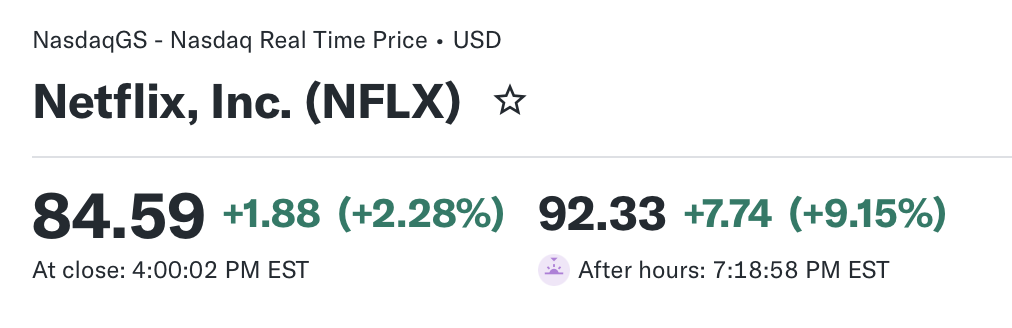
Netflix’s stock is up 9 percent in after-hours trading.
Acquisition Antitrust Business HBO Max Netflix Video Web
Mothers Ruin Software (Mastodon):
Restored the ability to decode recently-created URL Bookmarks. Apple changed this binary format in macOS 26.1, macOS 15.7.2 and macOS 14.8.2, and that would cause the decode to fail. Archaeology can now decode the new bookmarks, and will show the new (usually empty) Team ID therein.
[…]
Updated the app icon to be more compatible with macOS Tahoe squircle clipping. (This is about as far as we’re willing to go on this front.)
It’s unclear to me whether this format change means that aliases or app data created on newer versions of macOS won’t be forward compatible on older versions.
Previously:
Archaeology Liquid Glass Mac Mac App macOS Tahoe 26 Security Scoped Bookmarks
Ashley Belanger (Hacker News, 3):
The European Commission announced that X would be fined nearly $140 million, with the potential to face “periodic penalty payments” if the platform fails to make corrections.
A third of the fine came from one of the first moves Musk made when taking over Twitter. In November 2022, he changed the platform’s historical use of a blue checkmark to verify the identities of notable users. Instead, Musk started selling blue checks for about $8 per month, immediately prompting a wave of imposter accounts pretending to be notable celebrities, officials, and brands.
Today, X still prominently advertises that paying for checks is the only way to “verify” an account on the platform. But the commission, which has been investigating X since 2023, concluded that “X’s use of the ‘blue checkmark’ for ‘verified accounts’ deceives users.”
Twitter very publicly eliminated the verification program. The blue checkmark now indicates that you’re a premium subscriber (which I’m not, so I lost mine). If you click on a blue checkmark, it shows a popover stating, “This account is verified. Learn more,” with the link accurately describing what the checkmark means. There is still some level of verification (name, photo, phone number, “no signs of being misleading or deceptive”), but they no longer check your government ID. I don’t understand the argument that this is illegal. I did not see a requirement in the DSA that the word “verified” must have a certain meaning. (Government and other officials have a stricter verification process and get a grey checkmark.)
The other parts of the fine are because the DSA wants Twitter to allow researchers access to information about its ads and “the platform’s public data.” The DSA has some interesting requirements for ads. I’d like to see how the other large online platforms and search engines are complying with this. There is still a Twitter API for the public data—maybe the issue is that it’s paid? But most of the data isn’t really public anymore, anyway, since it requires logging in.
On Friday, Musk reposted criticism of the EU fine from a lawyer, Preston Byrne, who quoted Vance’s X post and suggested that Congress should act “ASAP” to pass a law that he proposed. If passed, that law “would allow X to sue the European Commission in US federal court for three times this amount and get injunctive relief against the Commission’s orders.”
Previously:
Advertising Business Digital Services Act (DSA) European Union Legal Twitter Web